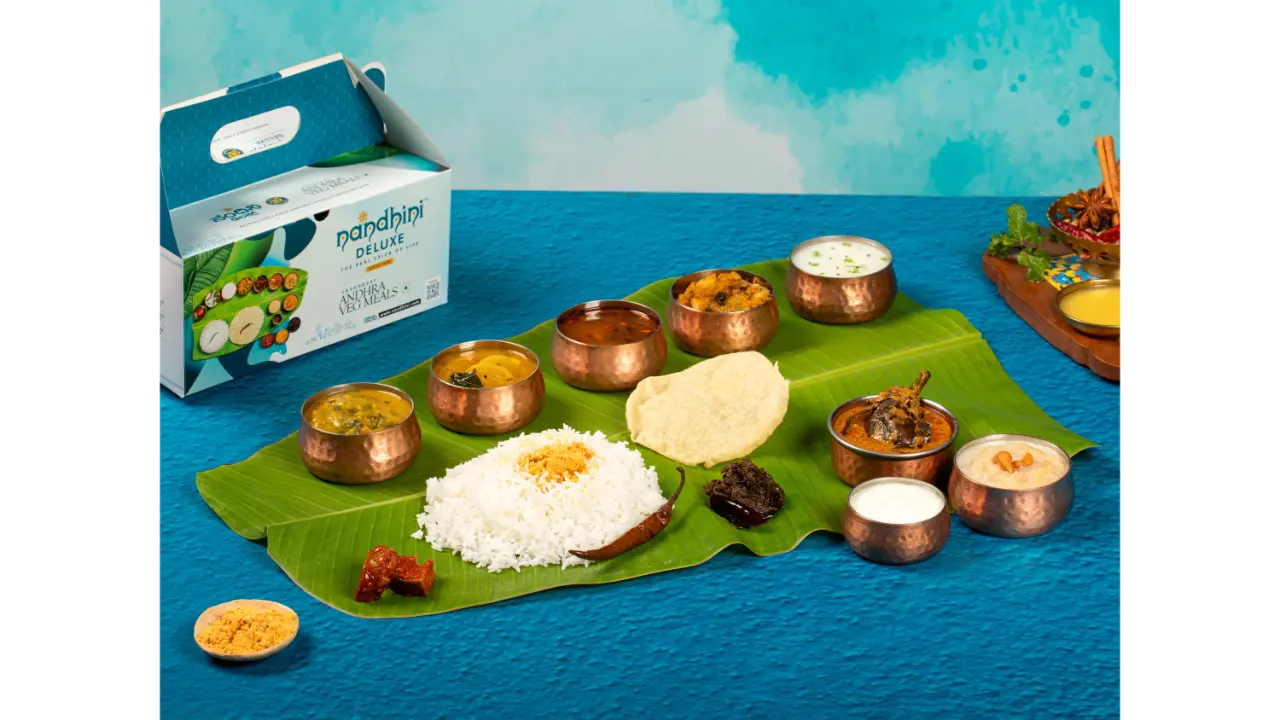
An Andhra thali has 10–12 items. Most people can name three: rice, dal, pickle. Here’s what the other nine are – and why each one earns its spot on the plate.
A thali isn’t a meal. It’s a system. Every bowl, every powder, every smear of pickle has a role – flavour, nutrition, temperature, texture. The Andhra cuisine tradition builds each plate around the Ayurvedic principle of six tastes: sweet, sour, salty, pungent, bitter, and astringent. You get all six in a single sitting, often without realising it.
This guide walks you through every item on an Andhra thali – Telugu names, what each dish actually tastes like, the traditional eating order, and how to navigate the whole spread without feeling lost. We’ve been serving these thalis at Nandhini since 1989 – around 10,000 of them a day across 15+ outlets in Bangalore. Consider this a seat at the table with someone who knows the menu by heart.
What’s on an Andhra Thali? (The Quick List)
Before we go deep, here’s the full andhra thali menu at a glance. Bookmark this if you’re reading on your phone before walking into the restaurant.
| Item (Telugu) | What It Is (English) | Role on the Thali | Flavour Profile |
| Pappu | Lentil stew | Protein base, mixed with rice | Mild, comforting, slightly earthy |
| Charu / Rasam | Tamarind-pepper broth | Palate cleanser, digestive | Tangy, peppery, light |
| Koora / Kura | Vegetable curries (dry + gravy) | Main accompaniments | Varies – spicy, tangy, or mild |
| Podi | Spiced powder (gunpowder) | Mixed with ghee and rice | Nutty, roasted, chilli-forward |
| Pachadi | Fresh chutney/relish | Cooling contrast | Tangy, sometimes sweet |
| Ooragaya / Pickle | Fermented pickle (avakaya, gongura) | Flavour punch | Intensely sour, spicy, salty |
| Annam (Rice) | Steamed white rice | Centre of the thali | Neutral – the canvas |
| Neyyi (Ghee) | Clarified butter | Richness, binding agent | Nutty, warm |
| Appalam (Papad) | Crispy lentil wafer | Texture contrast | Crunchy, salty |
| Perugu (Curd) | Fresh yoghurt | Cooling finish | Cool, creamy, slightly tart |
| Majjiga (Buttermilk) | Spiced buttermilk | Digestive coolant | Light, tangy, cumin-scented |
| Payasam / Sweet | Dessert (kheer, boorelu) | Meal closer | Sweet, often cardamom-laced |
That’s the standard andhra thali items list. Some restaurants add more; festive thalis push to 15 dishes. But these 12 are the foundation. Now let’s look at each one properly.
The Full Menu Breakdown: Every Item Explained
Pappu (Lentil Stew)
Pappu is where the thali starts making sense. It’s a thick lentil stew – not the watery dal you might know from North Indian restaurants. Andhra pappu clings to the rice. You mix it with your fingers, add a stripe of avakaya pickle, and that’s your comfort base sorted.
The types of pappu rotate daily in most Andhra restaurants. Mudda pappu (plain toor dal, mashed, with a spoon of ghee) is the simplest. Tomato pappu has a tangy warmth. Palakura pappu (spinach lentil) is earthy and iron-rich. Kandi pappu is the pure toor dal version, usually seasoned with curry leaves and dry red chilli. At Nandhini, the pappu changes with the day – you learn the weekly rhythm if you eat here often enough.
If you’re looking for high-protein options on the Andhra thali, pappu is your anchor. Two servings with rice will keep you full past 4pm.
Charu / Rasam
Charu is what Andhra people call rasam – a thin, tangy broth built on tamarind, black pepper, and garlic. It’s sharper than Tamil rasam. More tamarind, more chilli, less coconut. The heat is direct, not layered.
You drink charu in two ways. Mixed into hot rice with a drop of ghee, it’s the penultimate course – light enough to eat after heavier curries. On its own in a small bowl, sipped between bites, it cleanses your palate. The rasam powder used in Andhra kitchens tends to be heavier on black pepper and cumin than most commercial blends. That’s where the warmth comes from.
Koora (Curries)
Koora is the broad term for curries on the andhra leaf menu. You’ll usually get two or three: one dry, one with gravy. Vepudu is the dry-fry style – bendakaya vepudu (okra fry) is a staple, cooked until the edges crisp and the sliminess disappears entirely. Aloo tomato kura is a homestyle gravy, tangy and mild, a good counterpoint to the spicier items.
Pulusu-style curries use a tamarind-and-onion gravy base. They’re tangier than North Indian gravies, thinner, and they don’t rely on cream or cashew paste. The spice is upfront. If you want to understand why the curries on your thali pack serious heat, it comes down to Guntur Sannam chillies – they hit 30,000–50,000 on the Scoville scale.
Some thalis also feature coastal Andhra dishes you might find on the thali – fish pulusu, prawn vepudu, or royyala iguru (prawn curry). These rotate seasonally.
Podi + Ghee
This is what separates an Andhra thali from every other regional thali in India. Podi – sometimes called gunpowder – is a dry-roasted spice powder. Kandi podi (made with toor dal, red chillies, and cumin) is the most common. Karivepaku podi (curry leaf powder) has a more herbal, aromatic edge.
You mix it with ghee and hot rice. That’s your modhati muddha – your first bite. It’s tradition, not ceremony. The nuttiness of roasted dal, the slow burn of chilli, the richness of ghee, and the warmth of freshly steamed rice. Everything on the thali comes after this.
Pachadi and Pickle
Two different things, often confused. Pachadi is a fresh, yoghurt-based relish – gongura pachadi (sorrel leaf chutney) is a sharp, sour hit that cuts through rich curries. It’s made fresh and doesn’t last more than a day.
Ooragaya (pickle) is the fermented, oil-preserved version. Avakaya (raw mango pickle) is the most famous – fiercely sour, loaded with mustard and chilli. A thumbnail-sized amount mixed into a mound of pappu rice transforms the entire bite. The difference between pachadi and ooragaya is freshness versus fermentation. Both earn their space on the andhra style thali.
Annam (Rice)
Rice is not a side dish. It’s the centre. Everything on an Andhra thali is designed to be mixed with rice. The pappu goes into the rice. The podi goes into the rice. The charu goes into the rice. Even the pickle needs rice to make sense. Steamed white rice – short grain, slightly starchy – is the standard. It holds together when you mix with your fingers and absorbs gravy without dissolving into mush.
Sides: Papad, Curd, Buttermilk, Raw Onion
Appalam (papad) gives crunch. You crumble it over rice or eat it between bites for texture contrast. Perugu (curd) is the cooling closer – you mix it with rice at the end, sometimes with a pinch of salt and a strand of pickle. Majjiga (buttermilk) is spiced with cumin and curry leaves, sipped throughout the meal as a built-in cooling system. Raw onion slices, when included, add sharpness – especially useful alongside spicier curries.
Payasam and Sweets
The closer. Payasam (kheer) is the most common – vermicelli or rice cooked in milk with cardamom, sugar, and sometimes saffron. For festive thalis, you might find boorelu (stuffed sweet dumplings with jaggery and coconut) or pootharekulu (paper-thin rice wafers layered with ghee and powdered sugar). The sweet balances all the spice and tang that came before it. You don’t skip it.
Veg vs Non-Veg Andhra Thali: What Changes?
The core stays identical. Pappu, charu, podi, rice, ghee, pachadi, pickle, curd, papad, buttermilk, sweet – all present in both. What the non-veg andhra thali adds is one or two meat dishes alongside the vegetarian spread.
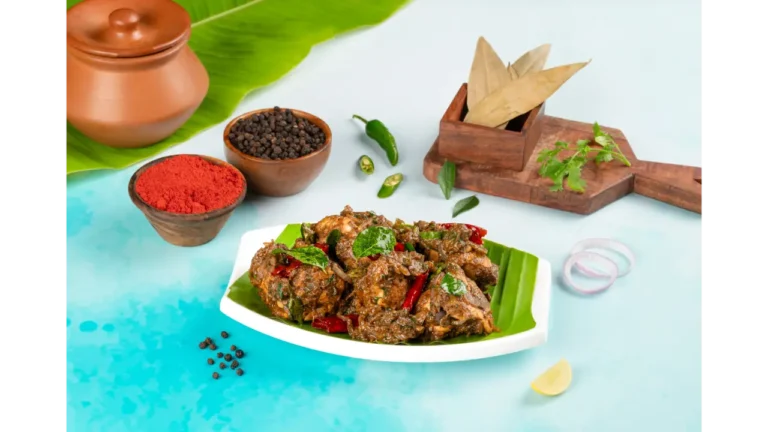
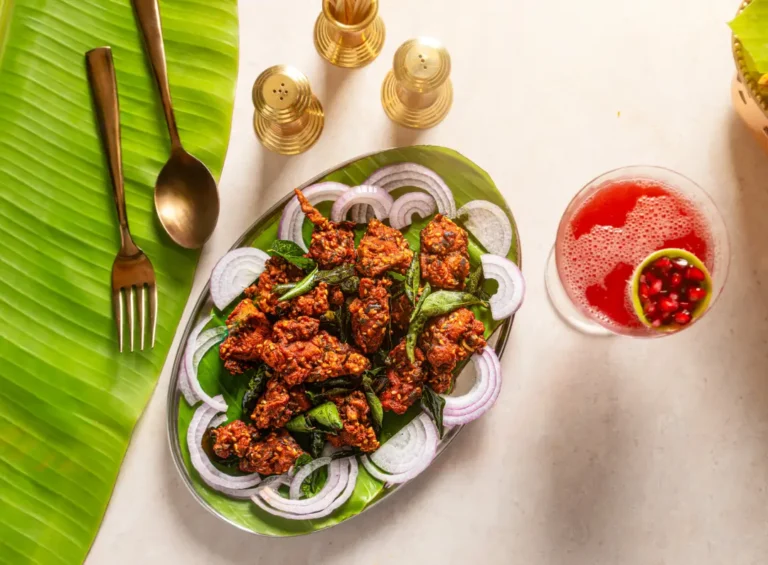
Kodi vepudu (chicken dry fry) is the most common addition – deep-fried pieces with curry leaf and chilli, crispy on the outside, juicy inside. Mutton curry (slow-cooked with onion-tomato gravy and whole spices) or fish fry (usually a firm white fish, shallow-fried with turmeric and chilli) also rotate depending on the day. The vegetarian items don’t disappear. They share the plate.
For a deeper look at what’s different, see our guide on veg vs non-veg thali at St Marks Road. Vegetarians looking for the full rundown should also read veg Andhra thali options in Bangalore.
How to Eat an Andhra Thali (The Traditional Order)
This is the part no one tells you. You sit down, a steel plate or banana leaf lands in front of you with 12 items, and suddenly you’re making decisions about where to start. Here’s the traditional andhra meals menu order – not a rigid rule, but a sequence that works.

Step 1: Modhati Muddha (The First Bite)
Mix podi with a spoonful of ghee and hot rice. Press it into a small ball with your right hand. This is the modhati muddha – the first mouthful. It’s warm, nutty, and sets the tone for everything after it. Tradition says this first bite should wake up your appetite. It does.
Step 2: Pappu + Rice + Pickle
Scoop pappu onto rice, mix, and add a small smear of avakaya or gongura pickle. This is the comfort course – mild lentils against sharp pickle. Most people eat two or three rounds of this before moving on.
Step 3: Koora with Rice
Work through the curries one at a time. Dry fry first (bendakaya vepudu, for instance), then the gravy curries. Mix each into a fresh mound of rice. Don’t combine curries – each one deserves its own round.
Step 4: Charu Rice
Pour charu over rice. This is intentionally light – tangy tamarind and pepper after the heavier curries. It resets your palate. Some people sip charu from a bowl between bites instead. Both approaches are traditional.
Step 5: Curd Rice
Mix perugu (curd) with rice, a pinch of salt, and a strand of pickle. This is the cool-down. After all the spice and tang, curd rice brings your palate to neutral. Majjiga (buttermilk) works alongside this course too.
Step 6: The Sweet
Payasam or whatever sweet the day brings. You end on sweetness. The meal is complete.
Banana leaf etiquette, if you’re eating traditionally: fold the leaf toward you when you’re done. It signals you enjoyed the meal. Fold away from you, and you’re telling the host the opposite. Is Andhra food spicy? Yes. But the thali itself is designed with built-in cooling: curd, buttermilk, and the eating order all manage the heat for you. If this is your first time, check our how to handle the heat if it’s your first time and the first-timer’s Andhra restaurant guide for more.
Unlimited Thali vs À la Carte: Which One?
Two ways to eat at an Andhra restaurant. The unlimited thali is a fixed price: you get the full spread – rice, pappu, charu, koora, podi, pachadi, pickle, papad, curd, buttermilk, sweet – and everything gets refilled until you’re done. Best choice if you want the complete andhra thali experience without thinking about what to order.
À la carte works better when you already know what you want – a specific biryani, a particular curry, starters. You trade the full thali experience for precision. For more on how the two compare, read the unlimited vs à la carte pricing breakdown.
What to Expect on Nandhini’s Andhra Thali
At Nandhini, the thali follows the traditional structure: pappu (rotating daily), charu, two koora options, podi, pachadi, ooragaya, steamed rice, ghee, papad, curd, and a sweet. The curries change with the day – Monday’s thali looks different from Thursday’s. The constants (pappu, charu, podi, rice) stay the same.
Available across all 15+ outlets in Bangalore – from the St. Marks Road flagship to the neighbourhood outlets in Koramangala, BTM Layout, and Whitefield. The best andhra thali in Bangalore is the one served consistently, and we’ve been doing this since 1989. For the full Nandhini menu, check what’s on today.
Frequently Asked Questions
How many items are in an Andhra thali?
A standard restaurant Andhra thali has 10–12 items including pappu, charu, koora, podi, pachadi, pickle, rice, ghee, papad, buttermilk, and a sweet. Festive or wedding thalis can have up to 15 dishes.
What is the difference between Andhra thali and South Indian thali?
Andhra thali uses bolder spices, fermented pickles like avakaya, signature podi powders mixed with ghee, and stronger tamarind-based charu. Generic South Indian thalis lean toward milder sambar, coconut chutneys, and less heat overall. The Andhra pradesh thali is built around intensity and contrast.
Is Andhra thali served on banana leaf?
Traditionally, yes – especially at weddings and festivals, where each dish has a specific placement on the leaf. Most Bangalore restaurants serve on steel plates, though some offer banana leaf on request or during special occasions.
What should I eat first on an Andhra thali?
Start with podi mixed with ghee and hot rice (modhati muddha), then move to pappu with pickle, followed by koora, then charu rice, and finish with curd rice and the sweet. The traditional order is designed to move from bold to cooling.
Is Andhra thali vegetarian only?
No. Andhra thalis come in both vegetarian and non-vegetarian versions. Non-veg thalis add items like kodi vepudu (chicken fry), mutton curry, or fish curry alongside all the standard vegetarian components. The andhra thali veg version is a complete meal on its own.
The System on the Plate
An Andhra thali isn’t a random assortment of dishes. It’s a system. Podi wakes up your palate. Pappu grounds you. Koora gives you the main event. Charu cleanses. Curd cools you down. The sweet closes the conversation. Once you understand the sequence, you stop being overwhelmed and start eating with intention.
For the complete picture of Andhra dining in Bangalore, read our full Andhra meal guide. And if you’re searching for an andhra thali near you, Nandhini has 15+ outlets across the city. Since 1989, the thali hasn’t changed much. It hasn’t needed to.
Your only job is to show up hungry. We’ll handle the rest.