Festival-night biryani in Bangalore usually goes wrong for one simple reason: people order when hunger peaks, not when they actually need the food on the table. Nandhini’s own online ordering guide already frames outlet choice, timing, and delivery route as important to how biryani arrives, and Google Maps traffic tools explicitly surface delays, crashes, construction, and road closures that can affect ETA. On a busy festival night, that means timing is not a small detail. It is the whole strategy.
So the best time to order biryani on a festival night is not one universal clock time. It is the time that gives your chosen outlet, route, and order enough room to reach you before your serving window starts. That is the most useful way to think about timing in Bangalore, where traffic conditions can change, delivery distance affects food quality, and app ETA is only part of the story.
Table of Contents
Why festival-night biryani gets delayed in Bangalore
Festival nights compress demand into the same dinner window. More people order around the same time, more kitchens are handling similar peaks, and the roads are often less forgiving. Google Maps says its traffic layers show delays, crashes, construction, and road closures, while Bengaluru Traffic Police’s ASTraM platform and app are built around congestion alerts, incident reporting, and event-related traffic awareness. That combination is exactly why normal weekday timing habits often fail on celebration nights.
There is also the food-quality side of the problem. Nandhini’s ordering guide says timing and outlet choice affect how biryani arrives, while its delivery-focused biryani page explicitly treats delivery as a question of heat, travel behavior, and convenience rather than only taste. In other words, a delayed biryani is not just “late.” It may also be less hot, less aromatic, and slightly softer than you wanted by the time everyone sits down.
The 3 timing lanes that matter
A useful way to plan festival-night delivery is to stop asking for a magic hour and instead decide which timing lane you are in.
Early planner lane
This lane is best for family dinners, guest nights, apartment gatherings, or any meal where serving time matters. You decide when the biryani should actually be opened and served, then work backward. If you are hosting, this is the safest lane because it gives you room for traffic, kitchen load, and minor ETA movement. It also fits Nandhini’s own delivery logic, which emphasizes outlet choice and timing as part of getting a better arrival experience.
On-time planner lane
This lane works for smaller groups, nearby outlets, and simpler orders. You are still planning ahead, but you are not leaving it to the last minute. This is usually fine when you are ordering from the closest outlet, keeping sides limited, and not trying to serve a large guest group all at once. Nandhini’s ordering guide repeatedly points users toward the nearest outlet, which is a strong clue that timing risk rises as distance rises.
Risky last-minute lane
This is the lane most people regret. It happens when guests are already seated, everyone is suddenly hungry, and the order is placed too close to the moment of serving. On festival nights, that is when the road, the kitchen, and the app can all work against you at the same time. Google Maps’ traffic tools and BTP’s ASTraM updates exist because congestion and incidents are real variables, not rare exceptions.
Plan by serving time, not by order time
This is the main rule that fixes most festival-night delivery problems.
Do not ask, “When should I click order?” Ask, “When do I want the biryani open, fluffed, and ready to serve?” Once you know that, work backward. Then choose the closest outlet, keep the order simple enough to move cleanly, and avoid adding extras that are not essential if the window is already tight. That logic follows directly from Nandhini’s own advice on route choice and delivery performance.
This matters because app ETA is not the same thing as real serving time. You still need a few minutes to receive the order, unpack it, open the lid briefly, release steam, and fluff the rice. Nandhini’s online-ordering guide already recommends a quick steam-release routine after delivery, which means even a “just on time” arrival is not truly table-ready the second the rider reaches your door.
What to order when timing risk is high
If you know there is a chance of congestion, late ordering, or a longer route, the biryani choice itself starts to matter.
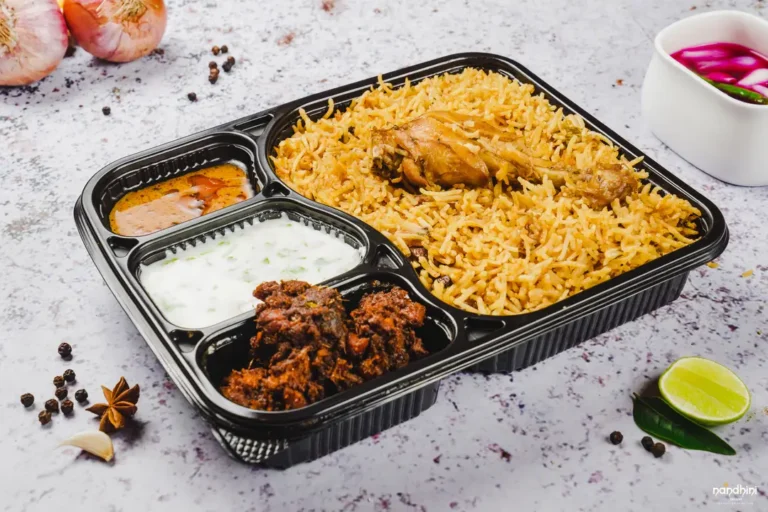
Nandhini’s delivery article says boneless tends to win for delivery because it is easier to eat, more consistent bite to bite, and cleaner if the biryani cools a bit in transit. That makes boneless a strong festival-night safety pick when ETA is uncertain or the dinner setup is more practical than ceremonial.
The same article also frames delivery as a travel-behavior issue, not just a taste issue. That means you should be cautious about turning a high-risk timing situation into a highly complex order. If the route is longer or traffic looks unstable, simpler biryani formats and fewer extras are often the smarter move. That is also where Nandhini’s family-pack and combo logic helps: group-friendly formats work best when they reduce decision clutter, not add to it.
The festival-night order checklist
Use this checklist before placing the order:
Choose the nearest outlet first. Nandhini’s online-ordering guide makes this the golden rule because distance affects heat, aroma, and delivery experience.
Check live traffic or congestion before you order. Google Maps can show delays, crashes, construction, and road closures, and BTP ASTraM is built for real-time traffic updates and congestion alerts in Bengaluru.
Decide your serving time before you decide your ordering time. This is the simplest way to avoid the “everyone is hungry now, let’s order now” mistake. It is an inference, but it follows directly from the way delivery, traffic, and post-arrival handling work.
Keep the order structure clean. The more items you add, the more chances there are for delay, packing friction, or a messy serving window. Nandhini’s family-pack and combo pages are useful precisely because they simplify group ordering.
Plan one cooling side, not five extra distractions. Nandhini’s sides guide treats raita as the main cooling support and positions side choices around function, not volume.
When the food arrives, open the lid briefly and fluff it. Nandhini’s ordering guide recommends a quick steam release to improve the eating experience after delivery.
When direct ordering, Swiggy, or Zomato makes sense on a festival night
Nandhini’s online-ordering guide already frames direct ordering, Swiggy, and Zomato as three viable routes with different strengths. Direct ordering makes the most sense when the meal is planned, the group is larger, or you want a more deliberate route for a family or guest dinner. Swiggy and Zomato are more useful when live ETA visibility and route tracking matter most. But on a festival night, none of those routes can fully rescue a poorly timed order. Timing discipline still matters more than platform preference.
That is the real takeaway. Platform choice can help with tracking and convenience, but it does not replace nearest-outlet thinking, traffic awareness, or serving-window planning. If the order is late, far away, or too complex, the app cannot make the biryani behave as though none of that happened.
The red-zone moments that usually cause delay regret
There are a few patterns that predict disappointment surprisingly well.
One is ordering only after guests arrive. Another is choosing a farther outlet just because a photo or listing looks better. Another is adding too many sides and starters when your window is already tight. And one of the biggest mistakes is assuming ETA equals eating time, when you still need a few minutes to unpack and settle the order. These are not abstract issues. They are exactly the kinds of problems that become more visible when traffic information, congestion alerts, and delivery behavior all matter at once.
You can catch many of these mistakes early by looking at the traffic layer before you order. Google Maps says red indicates traffic delays, with darker red meaning slower speeds, which is a useful visual signal when you are deciding whether your current plan is still sensible.
If the ETA starts slipping, what should you do?
First, do not panic and over-correct by adding more food elsewhere unless you truly need it. A slipping ETA does not always mean a failed dinner. It means you should simplify the rest of the meal and protect the serving experience.
If the order is still on the way, prepare the table, keep sides ready, and be realistic about how you will serve the biryani once it arrives. If you are using an app route, platform support exists for order issues and tracking, but the smarter move is to reduce avoidable timing risk before the order is placed. That is why the better article-wide advice is prevention, not rescue.
A copy-paste biryani timing script
For a family dinner at home:
“We want biryani delivered for a festival dinner and need it close to serving time. Please confirm the nearest outlet and the best delivery-friendly biryani option for this route.”
For guests arriving at a fixed time:
“We are planning a festival dinner for guests and want the order timed for serving, not just dispatch. Please suggest the safest biryani and side combination if traffic is moderate tonight.”
For an apartment or office gathering:
“We need a biryani order for a fixed dinner window. Please help with the nearest outlet, the most delivery-stable biryani option, and one simple cooling side.”
Those scripts work because they tell the restaurant what you are optimizing for: arrival quality and serving timing, not just menu selection.
Final thought
The best time to order biryani on a festival night in Bangalore is the time that respects the route, the outlet, the traffic, and your actual serving window. That is why “order early” is too vague to be useful on its own. A better rule is this: plan backward from the moment you want to eat, choose the nearest outlet, keep the order clean, and make delivery-friendly choices if the route looks uncertain. That approach is consistent with Nandhini’s own ordering logic, its delivery advice, and the real-time traffic tools available in Bengaluru.
If you do that, festival-night biryani stops feeling like a gamble and starts feeling like a plan.
FAQs
What is the best time to order biryani on a festival night in Bangalore?
The best time is not one fixed hour for everyone. It is the time that lets your nearest outlet reach you before your intended serving window, with room for traffic and post-arrival handling.
Should I order earlier than usual on festival days?
Usually yes, especially if the dinner matters to guests or family and you expect a busy citywide dinner rush. Festival nights compress demand, and live traffic tools exist precisely because delays and road issues are part of real-world routing.
Does the nearest outlet really matter?
Yes. Nandhini’s online-ordering guide explicitly treats the nearest outlet as the golden rule because distance affects heat, aroma, and overall delivery experience.
Which biryani travels better if timing risk is high?
Nandhini’s delivery article says boneless tends to perform better for delivery because it stays easier to eat and more consistent even if the biryani cools slightly.
What should I do when the biryani arrives?
Open the lid briefly, release steam, and fluff the rice before serving. That step is directly recommended in Nandhini’s online-ordering guide.