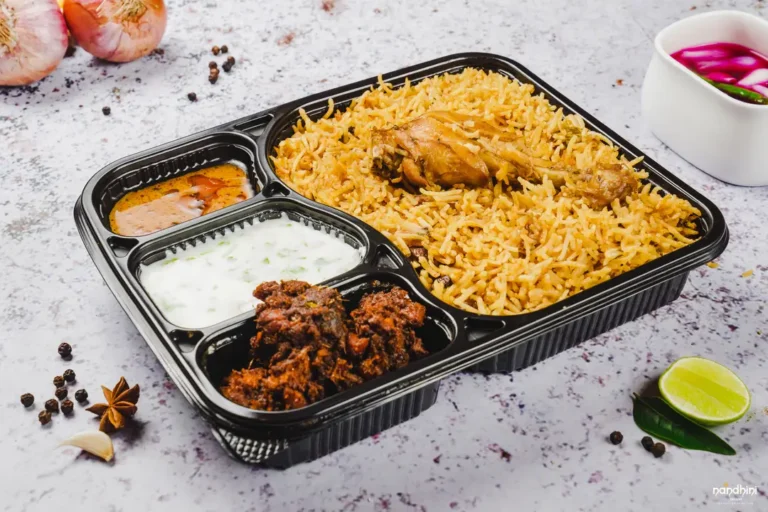
You ordered a family pack of chicken biryani. Half of it was demolished at dinner. The other half is sitting on the kitchen counter, still warm, looking at you.
Now what?
Store it right, and you’ve got a ready-made meal for tomorrow that tastes nearly as good as tonight. Store it wrong, or worse, leave it out too long, and you’ve got a food safety problem disguised as leftovers.
This guide covers exactly how long biryani lasts, where to store it, and how to tell when it’s time to throw it out. No vague “a few days” answers. Specific timelines, specific steps, adjusted for Indian kitchens and Bangalore weather.
Table of Contents
The Cheat Sheet: How Long Does Biryani Last?
Everything in one table. Bookmark this.
| Storage Method | Chicken Biryani | Veg Biryani | The Rule to Remember |
| Room temperature | Max 2 hours (1 hour if above 30°C) | Max 2 hours | Don’t let it sit out during a long dinner. Fridge it when you’re done eating. |
| Fridge (4°C or below) | 3–4 days | 4–5 days | Airtight container. Store within 2 hours of delivery or cooking. |
| Freezer (-18°C or below) | Up to 2 months | Up to 2 months | Portion before freezing. Label with date. |
That’s the short version. Now the details, starting with the one most people get wrong.

The 2-Hour Rule (and Why It’s Shorter in Bangalore)
Most food safety guidelines say cooked food can sit at room temperature for up to 2 hours before bacteria reach risky levels. That guideline comes from the USDA and assumes a room temperature of about 20–22°C.
Bangalore’s average temperature? 25–33°C for most of the year. Warmer rooms mean faster bacterial growth.
The practical adjustment: if your kitchen or dining room is above 30°C (which it often is from March to June), treat 1 hour as the safe window, not 2.
This matters more for biryani than for many other dishes because of the rice. Cooked rice is particularly hospitable to a bacterium called Bacillus cereus. Its spores survive cooking, and once the rice cools to room temperature, they multiply rapidly. The toxins they produce aren’t always destroyed by reheating, so the risk isn’t just “reheat it well and you’ll be fine.” The risk is in letting it sit too long before refrigerating.
The practical takeaway: when dinner is done, don’t leave the biryani on the dining table while you watch a movie. Fridge it. That single habit eliminates most of the risk.
Fridge Storage: Step by Step
Your biryani is headed for the fridge. A few steps to make sure it stays good for the full 3–4 days.
Step 1: Cool it down, but quickly. Let the biryani come to about room temperature before putting it in the fridge. Placing piping hot food directly in the fridge raises the overall fridge temperature, which can affect everything else stored in there. But “cool it down” doesn’t mean “leave it on the counter for three hours.” Aim for 20–30 minutes of cooling, then fridge it.
Step 2: Transfer from the delivery container. If your biryani arrived in a thin aluminium foil tray (the kind most restaurants and delivery apps use), move it to a proper container. Foil trays aren’t airtight, and the aluminium can react with acidic spices like tamarind or tomato-based masala over time. Thin plastic takeaway containers aren’t great either. They don’t seal well and tend to absorb odours.
Use a glass container with a snap-lock lid or a food-grade plastic container with a tight seal. Glass is ideal because it doesn’t absorb flavours and cleans easily.
Step 3: Make it airtight. The single most important step. Exposure to fridge air dries out the rice (making it hard and crunchy when reheated) and lets the biryani absorb fridge odours. Nobody wants biryani that smells like last week’s onions. Airtight seal, every time.
Step 4: Label it. Write the date on the container with a marker or stick a piece of tape on the lid. By day 3, you won’t remember if you ordered on Tuesday or Wednesday. A label removes the guesswork.
Step 5: Consume within 3–4 days for chicken biryani. Veg biryani gets an extra day (4–5 days) because vegetables are more stable than cooked chicken at fridge temperatures. After day 4 for chicken biryani, the safest move is to discard it, even if it looks and smells fine.
Freezer Storage: Step by Step
Freezing makes sense when you’ve ordered more biryani than you can eat in 3–4 days, or when you want to meal-prep for the week ahead.
Step 1: Portion before freezing. Don’t freeze the entire family pack in one container. If you freeze everything together, you’ll have to thaw the whole batch to eat a single serving, and you can’t refreeze what you’ve already thawed. Divide into individual or two-person portions.
Step 2: Use freezer-safe containers. Regular plastic containers can crack in the freezer, and cling film alone isn’t enough to prevent freezer burn. Go with thick-walled plastic containers with lids, glass containers (check they’re freezer-rated, since some glass cracks with temperature changes), or heavy-duty freezer bags with the air squeezed out.
Step 3: Leave some headroom. If using a container, don’t fill it to the brim. Food expands slightly when frozen, and a packed-full container can crack or pop its lid.
Step 4: Label with date and contents. “Chicken biryani, 24 Feb” written on tape. Future you will be grateful.
Step 5: Freeze within 2 hours of cooking or delivery. The same 2-hour window applies here. Cool the biryani to room temperature quickly, then freeze.
The texture reality: Frozen and thawed biryani rice will be slightly softer than fresh. This is unavoidable. Ice crystals form inside the rice grains during freezing and break down the cell structure slightly. The difference is minor, and reheating in a pan (rather than a microwave) helps restore texture. But if texture perfection matters to you, freezing is best reserved for biryani you’d otherwise throw away.
Shelf life in the freezer: Up to 2 months for best quality. After that, the biryani is still safe to eat (frozen food doesn’t technically expire if kept at a constant -18°C), but flavour and texture start to degrade.
Never refreeze thawed biryani. Once you’ve thawed a portion, eat it within 24 hours. Refreezing creates additional ice crystal damage and increases bacterial risk.
How to Thaw Frozen Biryani
The best way: Move the frozen container from the freezer to the fridge the night before you plan to eat it. It’ll take 8–12 hours to thaw depending on portion size. This is the safest method because the biryani stays at a safe temperature throughout.
The fast way: Use the defrost setting on your microwave. Place the frozen biryani in a microwave-safe dish, defrost in 2-minute bursts, stirring between each burst to distribute heat. Eat immediately after defrosting. Don’t thaw in the microwave and then leave it sitting on the counter.
The wrong way: Leaving frozen biryani on the counter to thaw at room temperature. The outer layer reaches the bacterial danger zone (25–60°C) while the centre is still frozen solid. This is exactly the scenario where food poisoning happens.
Once thawed, reheat using the pan, microwave, or oven method. We’ve written a complete guide to reheating biryani that walks through each approach step by step.

How to Tell If Biryani Has Gone Bad
Staring at a container of 3-day-old biryani wondering “is this still okay?” Here’s what to check:
Smell it. Fresh biryani has a warm, spiced aroma: cumin, cardamom, chilli, ghee. Spoiled biryani smells sour, acidic, or unpleasantly pungent. If the smell makes you hesitate, that hesitation is your answer.
Look at it. Mould is the obvious sign: green, black, or white fuzzy patches anywhere on the rice or chicken. Also watch for discolouration. Rice that’s turned yellow-grey when it shouldn’t be, or chicken with a greenish tinge.
Touch it. If the rice feels slimy or the chicken has a slippery film on it, bacteria have been at work. Fresh biryani rice is slightly sticky but not slimy. There’s a clear difference, and you’ll know it when you feel it.
The golden rule: When in doubt, throw it out. A fresh biryani order costs a few hundred rupees. A case of food poisoning costs you a day in bed, or worse. Never worth the gamble.
Store Smart, Eat Well
The whole point of storing biryani properly is simple: you made a great food decision when you ordered it. Now make a great storage decision so you can enjoy that same quality tomorrow.
Cool it fast. Container it tight. Fridge it within 2 hours. Label it. Eat it within 3–4 days. If you need longer, freeze it.
At Nandhini, our family packs are designed with planned leftovers in mind. Generous portions at a per-serve price that makes ordering once and eating twice a genuinely smart move. When you pair proper storage with proper reheating, that second meal isn’t a compromise. It’s a reward.
Now that your biryani is safely stored, here’s how to reheat it so it tastes as good as fresh. Our complete reheating guide covers the microwave, pan, and oven methods step by step.