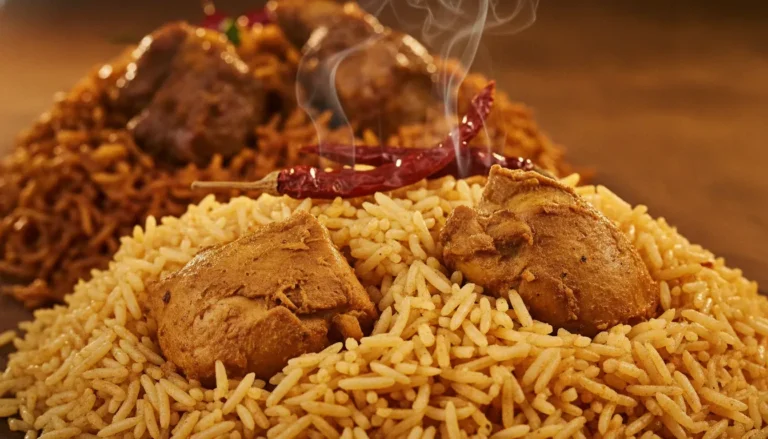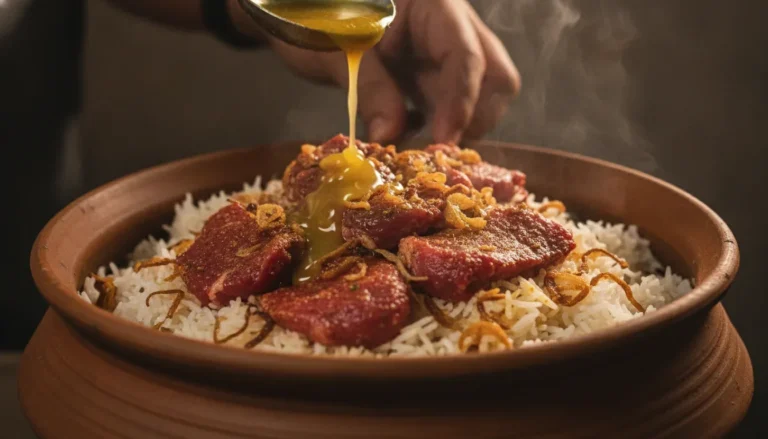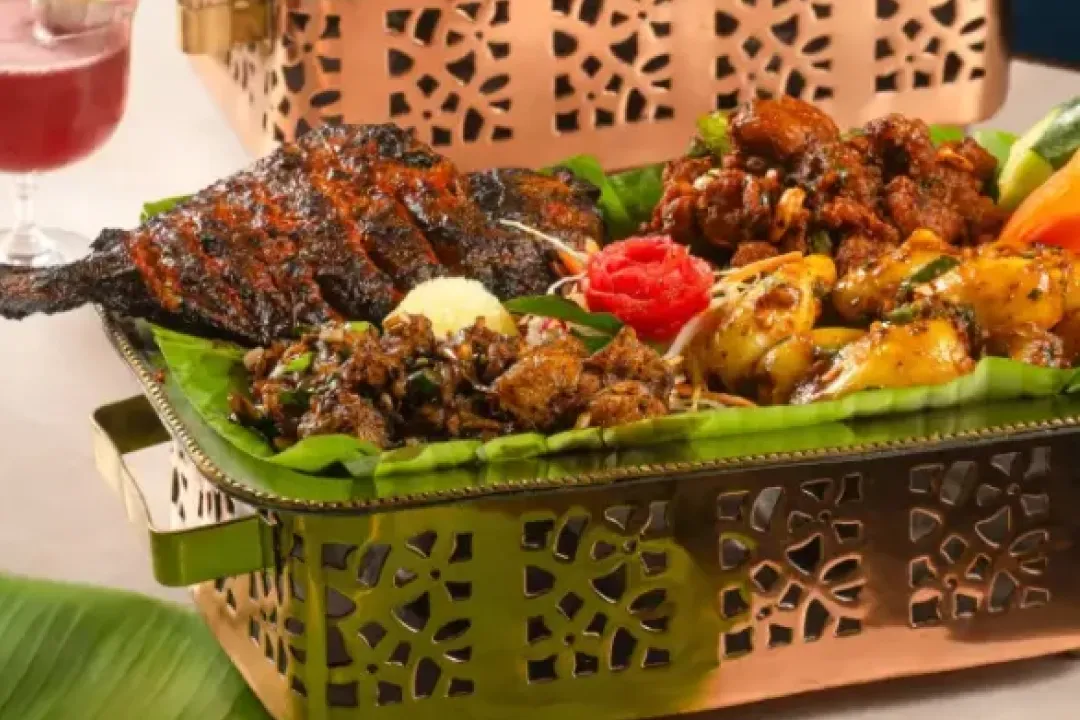
Bangalore now has more Andhra restaurants per square kilometre than almost any city outside Andhra Pradesh. It did not start that way. Walk the city in the early 1980s and a full Andhra meal on a banana leaf was a thing you mostly travelled home for, not something three streets offered at once. The history of Andhra food in Bangalore is really the history of a migration, and like every migration it came with people first and recipes second.
We have been part of that story since 1989, which gives us a particular vantage point on it. But the honest version begins before us, and telling it that way is the only way to tell it properly. This is how a fiery coastal cuisine crossed a state line, softened just enough to stay, and ended up on tables in nearly every neighbourhood in the city.
Why the Food Migrated in the First Place
Food rarely travels on its own. It moves when people move, and through the 1970s and 1980s a steady stream of families from Andhra Pradesh came to Bangalore for work, study, and the simple gravitational pull of a growing city. Public-sector firms, engineering colleges, and the early technology boom drew Telugu-speaking families across the border in numbers large enough to change what the city wanted for lunch.
Those families brought their kitchens with them. At first the food stayed domestic, cooked at home because nowhere outside served it the way it was meant to taste. Demand built quietly in that gap. When a community grows large enough to miss a specific kind of meal, someone eventually opens a place to serve it, and that is the moment a private cuisine becomes a public one. By the early 1980s that moment had arrived.
The pace picked up sharply through the 1990s and 2000s. As Bangalore became the country’s technology hub, the Telugu-speaking population grew again, this time with engineers and IT workers who wanted the food they grew up on within reach of the office. Any honest account of how Andhra food came to Bangalore has to give that second wave its weight, because it turned a steady presence into a defining one. The demand was no longer just from settled families; it was from a young, mobile workforce eating out several times a week.
The first places to answer the original 1980s hunger deserve their names said out loud.
The 1980s Pioneers, Named Properly
It would be easy, and wrong, to pretend the category began with us. It did not. A food-history feature in DNA India looking back at the city’s Andhra joints names early establishments such as Nandini and Amaravathi among the places that first carried the cuisine into Bangalore’s mainstream. These were the rooms where non-Telugu Bangaloreans had their first proper Andhra meal.
The clearest landmark predates us by five years. Nagarjuna opened on Residency Road in 1984, started by N. Krishna Reddy, who came from Nellore in coastal Andhra. It built a following for fiery, full-flavoured Andhra food and grew into several outlets over the following decades. When the question is who brought Andhra restaurant food to Bangalore, Nagarjuna and a handful of contemporaries have a fair claim to being there first, and any honest history has to say so.
What none of those early rooms had yet done was take the cuisine city-wide. That came later, and it is the part of the story we know from the inside.
How the Cuisine Adapted to a New City
A cuisine that crosses a border has a choice to make. It can stay exactly as it was and remain a niche for homesick loyalists, or it can bend slightly toward its new audience and spread. Andhra food in Bangalore did the second thing without losing its spine. The Andhra cuisine that settled here kept its heat and its sour tamarind backbone, but learned to balance them for palates raised on milder Karnataka meals.
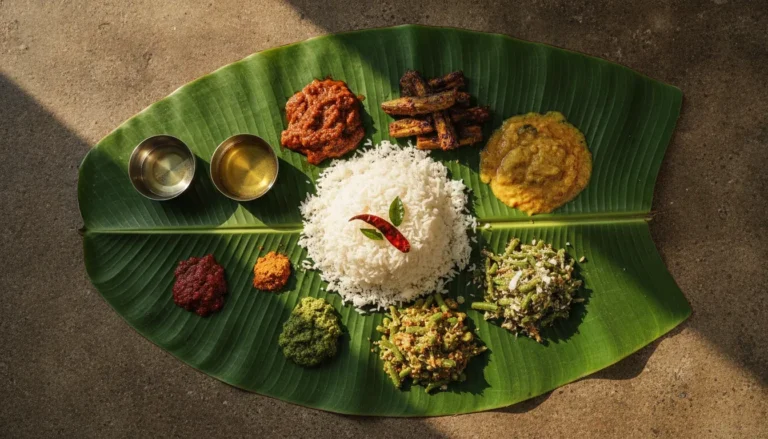
The banana-leaf format survived the journey intact. The bhojanam (the meal), an unlimited spread of rice, pappu (dal), pulusu (tamarind curry), kooras (vegetable curries), pickles, podi (spice powder), papad, curd and a sweet, is still served the way it always was. What shifted was at the edges. The fiercest Rayalaseema-style dishes were offered alongside gentler coastal preparations, so a table could choose its own level of heat. That flexibility is a large part of why the food stuck.
It is worth being clear about what did not change, because that is where the cuisine kept its identity. The core templates held firm. Pappu stayed a thick, comforting dal cut with a souring agent. Pulusu kept its tamarind tang. Gongura held its place as the signature sour green that no other regional cuisine in the city offered. Pickles stayed aggressive rather than apologetic. The adaptation was a matter of range and presentation, giving the diner more choice at the milder end, not a dilution of the dishes themselves. A Coastal Andhra family from Vijayawada eating in Bangalore would still recognise everything on the leaf, which is the test that matters.
It is worth understanding the two Andhras on a plate here, because the distinction explains a lot. Most Andhra food in Bangalore draws from Coastal Andhra, where the cooking leans on tamarind, fresh chillies and a slightly rounded heat. Rayalaseema, the drier interior, cooks hotter and earthier, with more dry-roasted spice. A good Bangalore kitchen carries both, and the diner rarely realises they are tasting a regional map as much as a menu. You can see how that map plays out neighbourhood by neighbourhood in our Andhra meals area guide for Bangalore.
The Banana Leaf Versus the Northern Thali
People new to the format often ask how an Andhra meal differs from the north Indian thali they already know, and the answer runs deeper than the dishes. A northern thali tends to arrive in small steel bowls, portioned and largely fixed. The Andhra bhojanam is served directly onto a banana leaf and is unlimited by design, refilled by servers moving down the rows until you fold the leaf to signal you are done.
The leaf is not decoration. It changes the temperature and faintly the flavour of what sits on it, and it sets the rhythm of the meal, which is communal, fast, and built around rice rather than bread. Where a northern thali is a fixed, pre-portioned selection, the bhojanam is closer to a feast with rules. Both are satisfying in their own logic, but they are not the same act of eating, and the difference is most of why the Andhra meal felt genuinely new to the city when it arrived.
Underneath the format sits the one ingredient that defines the whole cuisine.
The Guntur-Chilli Spice Philosophy
You cannot tell the history of Andhra food in Bangalore without the chilli that carries it. The Guntur chilli, grown around the Guntur region of Andhra Pradesh, sits at roughly 30,000 to 50,000 on the Scoville scale, which places it well above the everyday Kashmiri or Byadgi chillies most Karnataka kitchens reach for. That single ingredient is why Andhra food reads as hot to a first-time diner.
But heat alone is a caricature of the cuisine, and the real philosophy is about balance. Guntur chilli is paired with tamarind for sourness, gongura (sorrel leaf) for a tart green edge, ghee for richness, and curd or buttermilk to cool the finish. The skill is in the counterweights, not the fire. A well-made Andhra meal does not leave you scorched. It leaves you with a long, layered warmth that the curd and the closing sweet bring back down to earth. If you want the full picture of where that heat sits and how to read it, our note on the spice levels behind Andhra heat breaks it down. Understanding that balance is the difference between fearing Andhra food and loving it.
From Niche to City-Wide
This is where our own thread joins the larger one. When Nandhini opened at Minerva Circle in 1989, the early rooms had proven there was an appetite for Andhra food in Bangalore, but it was still a scattered, mostly standalone affair. What had not happened yet was scale, the move from a handful of beloved addresses to a cuisine you could find reliably across the whole city.
That is the part we set out to do, and the part we would claim. Over 37 years the same Andhra meals, built on Guntur chillies brought in directly from the source, grew from one outlet to more than 19 across Bengaluru and Mysuru, all company-owned, now serving upward of 10,000 guests a day. We were not the first to bring Andhra food to Bangalore, and we have never said we were. What we did was turn it from a niche you sought out into a category the city takes for granted, which is a quieter kind of milestone but a real one.
The proof of how far the cuisine has travelled is in the ordinary density of it now. Andhra restaurants sit in nearly every neighbourhood, from the old central rooms to the newer suburbs, and Bangalore carries among the highest concentrations of them anywhere outside Andhra Pradesh itself. A food that arrived as a homesick memory became part of the city’s default. That is what a successful migration looks like on a plate, and it is why the history of Andhra food in Bangalore is no longer a niche subject but a thread running through how the whole city eats.
A City’s Plate, Permanently Changed
The story has a tidy shape only in hindsight. At the time it was just families missing a particular meal, a few brave rooms serving it, a cuisine quietly adjusting its heat, and a city slowly deciding it liked tamarind and Guntur chilli after all. No one planned the outcome. It simply happened the way food history usually happens, one craving and one kitchen at a time.
If you want to walk the modern version of this map, our own guides lay it out in detail, from the full city overview in our guide to Andhra food across Bangalore to the dish-by-dish breakdown of what a proper Andhra meal looks like. They are the present-day end of the history this article began with.
Food travels with people. Andhra food came to Bangalore in the 1980s and never left, and the city’s plates have been better for it ever since.