If you’ve ever ordered biryani for a group in Bangalore, you already know the emotional rollercoaster:
- You order “one pack” and it’s not enough, so everyone eats like they’re rationing.
- You order “too much” and end up with three boxes in the fridge and mild guilt.
- You order one spice level and half the group quietly suffers, while the other half says, “It’s perfect.”
That’s why family packs exist.
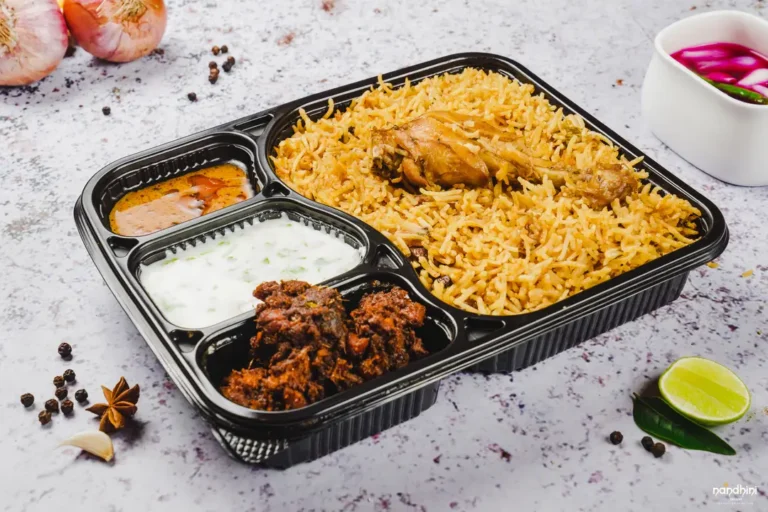
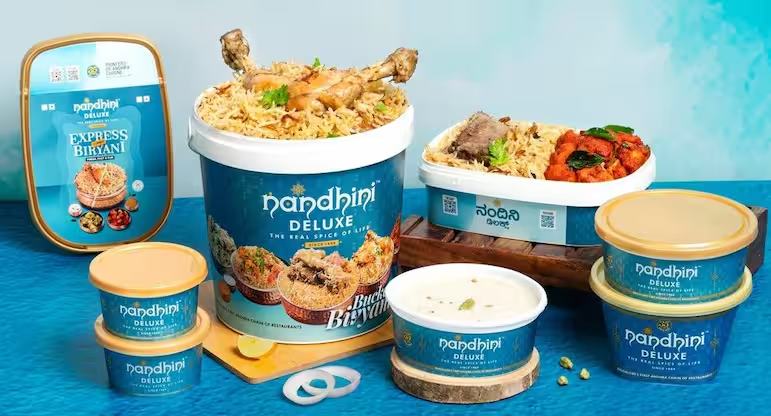
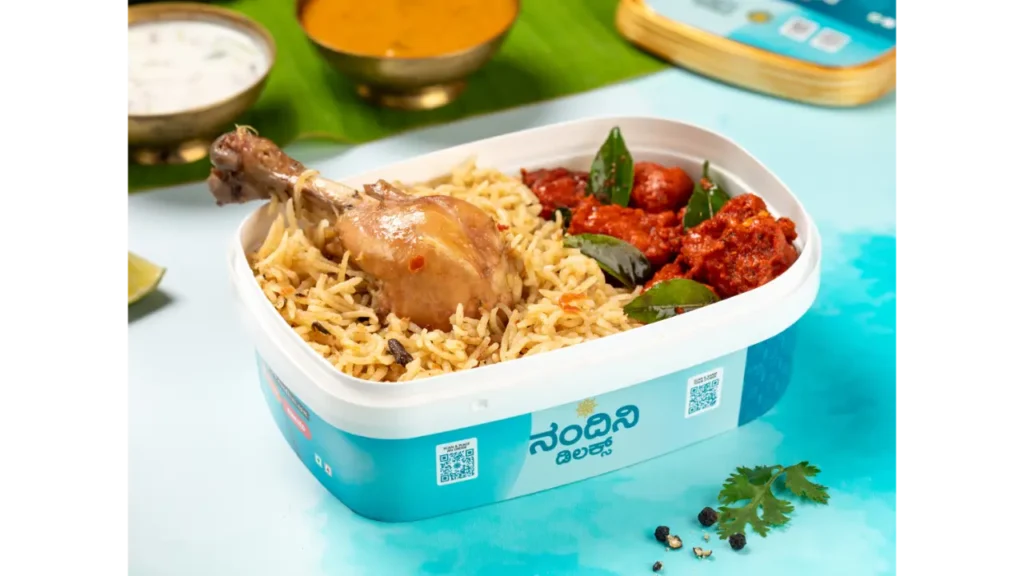
A biryani family pack (often called a bucket biryani in Bangalore ordering language) is meant to reduce chaos: fewer items to decide, easier serving, and better value compared to ordering everything as separate portions.
This guide will help you do three things with confidence:
- Pick the right size (3–4, 5–7, or 8+ people)
- Build smart combos (veg/non-veg, spice split, kids + elders, office lunch)
- Spend smarter (value tips, waste prevention, what not to over-order)
No links. No complicated math. Just a repeatable way to order biryani for families, friends, and office groups in Bangalore without regret. Visit Nandhini deluxe for its luxury experience.
Table of Contents
Quick Picks: What to order based on group size
For 3–4 people (classic family meal)
- 1 biryani family pack
- 1 cooling support item (curd/raita style support)
- Optional: 1 starter to share (only if the group is extra hungry)
For 5–7 people (small gathering)
- 2 “lanes” of biryani (comfort + spicy OR veg + non-veg)
- 1–2 starters (mild + spicy split)
- Cooling support (non-negotiable if spice levels vary)
For 8+ people (party mode)
- 3 main lanes (comfort + spicy + one veg balance option)
- More cooling support than you think
- Serve in portions first, don’t mix the whole pack
For mixed veg + non-veg groups
- One veg lane + one chicken lane
This prevents veg eaters from feeling like an afterthought.
For kids + elders
- Boneless lane + comfort lane
Less mess, safer heat.
What is a “family pack” or “bucket biryani” in Bangalore ordering language?
In Bangalore, “family pack” usually means one large biryani pack intended to serve multiple people. On many menus you’ll even see family packs listed as “serves 3–4” or bucket categories.
But here’s the truth that saves you money:
A family pack does not magically feed the same number of people every time.
Serving depends on:
- Age mix (kids vs adults)
- Hunger level (weekday dinner vs weekend gathering)
- Whether you have starters and sides
- Spice tolerance (spicy biryani slows eating for some people)
So instead of trusting a label blindly, use a simple sizing framework.
The only sizing framework you need (no math headache)
Step 1: Identify your crowd type
Pick one:
- Light eaters
People who take smaller portions, eat slowly, and stop early.
- Normal eaters
Most groups fall here. Comfortable portions, moderate hunger.
- Hungry eaters
Weekend mode, post-work hunger, guests who really came to eat.
Step 2: Use the “adult equivalent” rule
This is the easiest way to estimate quantity without arguing:
- 1 teen = 0.75 to 1 unit
- 1 kid = 0.5 unit
- 1 very hungry adult = 1.25 units
Now add your units and round up slightly if it’s a celebration.
Step 3: Decide if you need “support food”
If you have starters, gravies, or sides, your biryani quantity can be slightly lower.
If biryani is the only main, you need more.
Rule of thumb:
- “Biryani only” meals need more quantity.
- “Biryani + starters + sides” meals need less biryani.
This framework prevents both under-ordering and the dreaded fridge overflow.
Family pack sizing: what to order for 3–4 people, 5–7 people, and 8+
Instead of giving you confusing grams, here’s a practical “what to order” plan.
1) What to order for 3–4 people (the most common family pack scenario)
This is where family packs shine: easy decision, easy serving, good value.
If it’s a normal weekday dinner
- 1 family pack (choose your lane: comfort OR spicy)
- 1 cooling support item (especially if spice tolerance is mixed)
If your group includes spice-sensitive people
- Choose a comfort lane biryani for the family pack
- Add a spicy starter on the side for heat lovers
This gives spice lovers their thrill without forcing it on everyone.
If everyone is hungry (weekend vibe)
- 1 family pack + 1 starter
But do not add three starters. That’s how over-ordering happens.
Why this works:
One family pack creates a shared center-of-table experience. You keep the group aligned instead of splitting into individual portions that vary wildly.
2) What to order for 5–7 people (small gathering, big appetite variety)
This is where many people get it wrong. They either:
- order one massive thing and hope everyone likes it, or
- order ten items and create chaos.
The correct move is the two-lane strategy.
The two-lane strategy (best for 5–7 people)
Pick two biryani lanes:
- Lane A: Comfort lane (balanced, crowd-friendly)
- Lane B: Spicy lane (for heat lovers)
Or if your group is mixed veg/non-veg:
- Lane A: Veg lane
- Lane B: Chicken lane
Add:
- 1–2 starters max (split mild + spicy if possible)
- Cooling support (curd/raita style support)
Why two lanes wins:
It prevents group regret. People can mix based on preference. The table feels abundant without being wasteful.
3) What to order for 8+ people (party or big family gathering)
When you cross 8 people, ordering becomes a system. Your goal is:
- Enough food
- Enough variety
- Minimal waste
- Easy serving
The three-lane strategy (best for 8+ people)
- Lane A: Comfort lane biryani
- Lane B: Spicy lane biryani
- Lane C: Veg balance option (for variety and mixed diets)
Then:
- 2–3 starters total
- Cooling support (don’t skip this)
Serving rule for big groups
Do not open the pack and mix everything immediately.
Instead:
- Serve portions first
- Let people add more if they want
- Keep remaining biryani layered as long as possible
This improves texture and reduces waste.
The smartest combos that actually work (copy-paste templates)
Here are plug-and-play combo templates you can use without thinking too hard.
Template 1: Mixed veg + non-veg family gathering (4–6 people)
- 1 veg lane
- 1 chicken lane
- Cooling support item
- 1 mild starter OR 1 spicy starter (choose based on group)
Why it works:
Veg eaters feel included, chicken eaters feel satisfied, everyone can mix.
Template 2: Spice-split family dinner (3–5 people)
- 1 comfort lane family pack
- 1 spicy starter OR 1 spicy side
- Cooling support item
Why it works:
Spice lovers get their kick without turning the main dish into a challenge.
Template 3: Kids + elders at the table (4–6 people)
- 1 comfort lane biryani
- 1 boneless lane (if available)
- Cooling support item
- Avoid overly spicy starters
Why it works:
Boneless reduces mess and helps picky eaters. Comfort lane keeps everyone safe.
Template 4: Office team lunch (5–10 people)
- 2 biryani lanes (boneless lane + balanced lane)
- 1 starter max (easy-to-serve)
- Cooling support item
- Serve portions, don’t mix everything
Why it works:
Office lunch needs convenience, not spice bravery. Boneless is a productivity-friendly choice.
Template 5: Weekend “everyone is hungry” gathering (6–8 people)
- 2 biryani lanes (comfort + spicy)
- 2 starters (mild + spicy split)
- Cooling support
- Optional: one veg balance item if needed
Why it works:
It feels generous but still controlled.
Family pack vs ordering multiple single biryanis (which is better value?)
This is where the “value guide” matters.
Family pack usually wins when:
- You’re feeding 3+ people
- You want a shared center-of-table meal
- You want fewer decisions and less ordering friction
- You want easier serving and fewer containers
- You want predictable satisfaction for the group
Single biryanis usually win when:
- Everyone wants a different spice level
- People are picky about style (one wants Hyderabadi, one wants Andhra, one wants rustic)
- You’re feeding 2 people and both want different items
- It’s a work lunch and people prefer individual portions
The value truth
Most over-spending doesn’t come from choosing family packs vs singles.
It comes from ordering too many extras on top of the main.
Family packs feel like a “deal,” so people add more items, and that’s how the bill explodes.
The top 7 mistakes people make with biryani family packs (and fixes)
Mistake 1: Ordering one spice level for everyone
Fix: Use two-lane strategy (comfort + spicy).
Mistake 2: Over-ordering starters
Fix: Limit to 1–2 starters for 3–7 people. For 8+ people, cap at 2–3 starters.
Mistake 3: Ignoring cooling support items
Fix: Always add at least one cooling support item if spice tolerance varies.
Mistake 4: Ordering only non-veg for mixed groups
Fix: Include a veg lane. Mixed groups always appreciate it.
Mistake 5: Mixing the entire pack immediately
Fix: Serve portions first, mix only what you’re eating.
Mistake 6: Trusting “serves X” labels blindly
Fix: Use the adult-equivalent units framework.
Mistake 7: Ordering too much rice and too little balance
Fix: Pair biryani with one good side or starter, not five.
How to order family packs for delivery (without repeating the whole delivery guide)
Family packs can arrive softer if they travel long because steam has more time to settle.
Here’s the short version of what helps:
Delivery-friendly family pack rules
- Choose the nearest outlet available
- When it arrives, open the lid for 30–60 seconds (steam release)
- Fluff gently once
- Serve in portions first
- If it’s slightly cool, use gentle reheat once, not multiple times
That’s all you need for most situations.
How to serve biryani family packs like a host (simple but effective)
Serving makes people think the food is better. Seriously.
The “host mode” serving routine
- Put the biryani pack on the table
- Open it and let it breathe for 30 seconds
- Serve portions into plates
- Keep cooling support available
- Offer “spicy lane” and “comfort lane” options clearly
What this avoids:
- People digging into the pack aggressively
- Rice getting crushed
- Confusion about what is spicy and what is mild
It also makes the meal feel like an event, not a delivery box situation.
The “value guide” for spending smart (and not wasting food)
If you want maximum value without waste, follow these principles:
Principle 1: Spend on variety, not volume
For 5–7 people, two lanes of biryani is better value than one huge lane plus five starters.
Principle 2: Support items improve enjoyment more than extra mains
One cooling support item can make spicy biryani enjoyable for everyone. That’s better value than ordering more biryani to “compensate” for spice regret.
Principle 3: Don’t over-order because people “might” come
If you have uncertain attendance, order for the confirmed group and add one flexible extra item, not multiple packs.
Principle 4: Kids eat less than you think
Kids often snack and stop early. Use the adult-equivalent framework to avoid over-ordering.
Principle 5: Leftovers should be planned, not accidental
If you intentionally want leftovers, order one extra lane. If you don’t, keep it tight.
FAQs: Biryani family packs in Bangalore
1) How many people does a biryani family pack serve?
Many menus label family packs as serving multiple people (often 3–4), but actual serving depends on appetite, sides, and group mix. Use the adult-equivalent framework for better accuracy.
2) What’s the difference between a family pack and bucket biryani?
In Bangalore ordering language, they are often used similarly: a large pack meant for group serving. Names vary by restaurant and platform.
3) How much biryani should I order for 6 people?
For 6 people, two lanes of biryani (comfort + spicy or veg + non-veg) usually works better than one pack. Add one cooling support item and limit starters.
4) What is the safest order for a mixed veg and non-veg group?
One veg lane + one chicken lane + cooling support. This covers preferences and avoids awkwardness.
5) Is boneless better for group orders?
Boneless can be easier for serving and eating, especially with kids, elders, or office lunches. Bone-in can feel more traditional. Choose based on the group.
6) How do I avoid wasting food when ordering family packs?
Limit starters, use the adult-equivalent framework, and choose two lanes instead of overloading on volume.
Conclusion: Family packs are not about “more food,” they’re about smarter food
The best thing about biryani family packs in Bangalore is not just that they feed more people. It’s that they reduce decision fatigue and help you create a shared meal without chaos.
If you remember only four things from this guide, make it these:
- Use the adult-equivalent framework (adults, kids, hunger level)
- For 5–7 people, always use two lanes (comfort + spicy or veg + non-veg)
- Don’t over-order starters (they are the #1 budget trap)
- Serve portions first and release steam (texture and experience improve instantly)
Do this, and your next family pack order will feel confident, generous, and worth every rupee—without the leftover regret.