By two in the afternoon in coastal Andhra, the sun has flattened everything. The morning’s chilli-heavy curries have done their work, the mouth is still warm from Guntur heat, and the meal is not going to end on a sweet. It ends on something cool. A mound of perugu annam (curd rice), soft and just-set, or a ladle of majjiga charu (spiced buttermilk) poured over a small heap of rice. These are Andhra’s cooling dishes, the deliberate last course in a cuisine built on heat. This page explains what each one is, the names they travel under, how each is really made, and why food this fiery leans on curd and buttermilk to finish.
| Perugu annam and majjiga charu are Andhra’s two everyday cooling dishes: curd rice and spiced buttermilk. Both are curd-based, both are eaten with rice that has been cooled first, and both exist to balance a chilli-forward meal. One is a soft dish you eat by the spoonful, the other a thin pour you spoon over rice. |
Table of Contents
What is perugu annam?
| Perugu annam (curd rice) is a South Indian dish of cooked rice mixed with plain curd and a light tempering of mustard seeds, curry leaves and green chilli, served cool. In Telugu, perugu means curd and annam means rice. It is also called daddojanam or thayir sadam. |
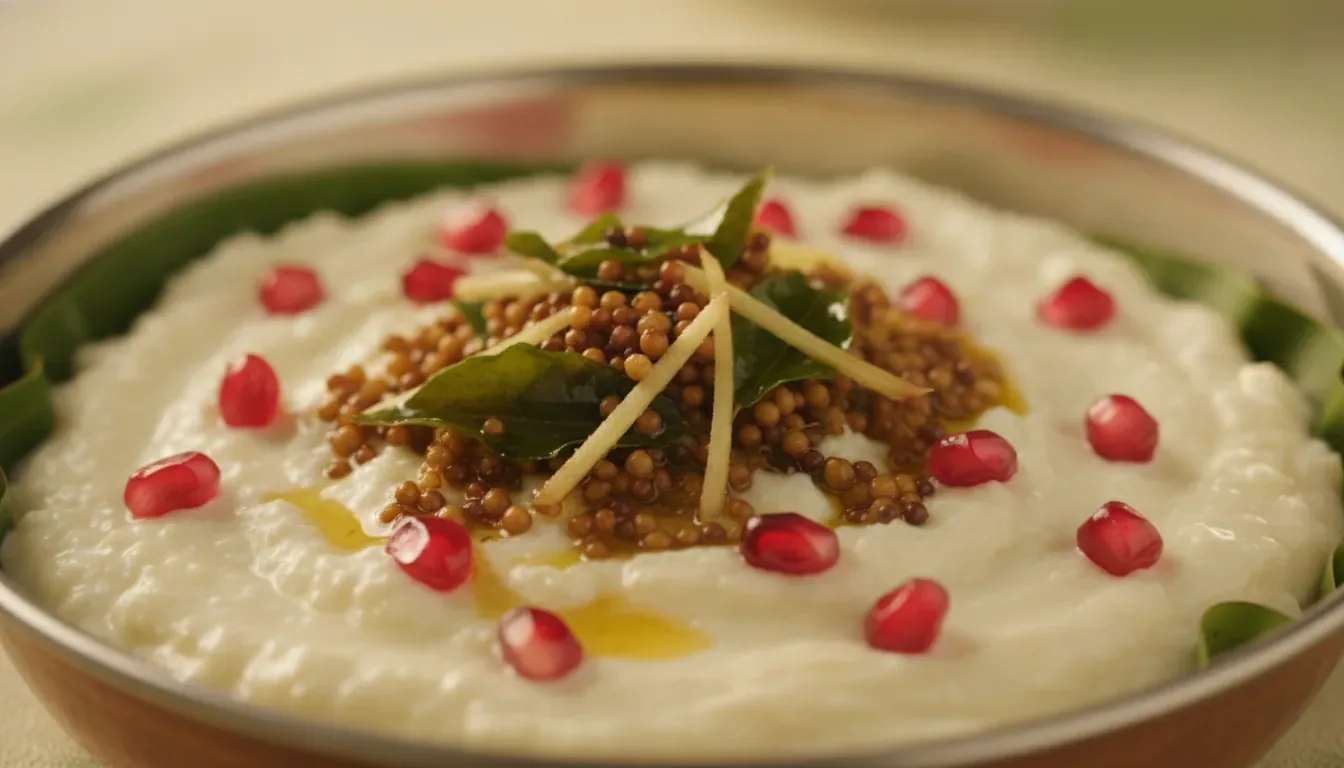
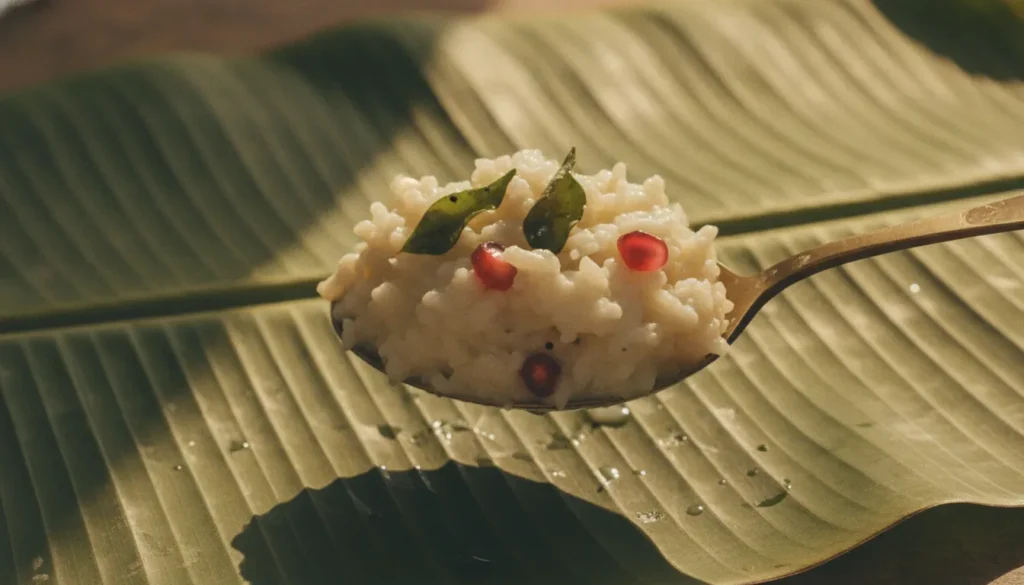
Strip it back and perugu annam is the plainest thing on the table: rice, curd, a little salt, and a tempering spooned over the top. What separates a good one from a canteen version is texture. The rice is cooked soft, almost past the point you would want for a pulao, then cooled and folded through thick curd, often with a splash of milk so it stays creamy rather than tightening into a solid block by the time it reaches the table. The tempering carries mustard seeds, curry leaves, green chilli and sometimes grated ginger. A scatter of pomegranate seeds on top is common in home versions and gives a cold, sweet-sour bite against the sour curd. It is the food given to children and to the elderly, the plate you reach for when nothing else will sit well. On English menus abroad it turns up as yogurt rice; in Karnataka the same dish is mosaranna.
What is majjiga charu?
| Majjiga charu (spiced buttermilk), also called majjiga pulusu or buttermilk rasam, is an Andhra dish of seasoned, tempered buttermilk. It is thin and pouring, spiced with green chilli, ginger, cumin and curry leaves, warmed gently and eaten spooned over cooled rice. In Telugu, majjiga means buttermilk and charu means a thin soup. |
The word charu tells you the consistency before you taste it: thin, almost pourable, closer to a rasam than a gravy. Made well, majjiga charu is buttermilk coaxed into something savoury and warm without ever being brought to the boil, because buttermilk splits the moment it does. Sour curd is the point here, not a flaw. This is a dish born of thrift, a way to use curd that is a day past fresh and turning, whisked loose with water, seasoned, and tempered. Telugu kitchens also call it perugu charu. Cross a border and it reappears under other names: majjige saaru in Karnataka, mor kuzhambu in Tamil Nadu, a coconut-rich moru curry in Kerala. Every version does the same job at the table, which is to settle a heavy meal and help it go down.
The one thing that confuses everyone: the names
Search either dish and the results scatter across half a dozen names, most of them the same food in a different language. Here is the map, so you can stop second-guessing which name means what.
| Name | Where it is used / what it means |
|---|---|
| Perugu annam | Telugu for curd rice (perugu = curd, annam = rice) |
| Daddojanam | Telugu for tempered, temple-style curd rice, often served as prasadam |
| Thayir sadam | Tamil name for curd rice |
| Mosaranna | Kannada (Karnataka) name for curd rice |
| Bagala bath | Another South Indian name for tempered curd rice |
| Yogurt rice | The common English handle on menus abroad |
| Majjiga charu | Telugu for thin spiced buttermilk (majjiga = buttermilk, charu = thin soup) |
| Majjiga pulusu | The thicker, vegetable version of the same dish |
| Perugu charu | A curd-based variant name for the buttermilk dish |
| Majjige saaru | Kannada (Karnataka) cousin |
| Mor kuzhambu | Tamil Nadu buttermilk curry |
| Coconut moru curry | Kerala buttermilk curry |
The short version: perugu annam, daddojanam, thayir sadam and mosaranna are one dish under four flags. Majjiga charu, majjiga pulusu, majjige saaru and mor kuzhambu are the buttermilk side of the same idea.
Charu vs pulusu: thin versus stew
The one distinction worth getting right is charu against pulusu, because they are not interchangeable and menus rarely explain the difference. Charu is the thin pour. Pulusu is the fuller, stewed cousin, thickened or bulked with vegetables. Same buttermilk base, two different dishes.
| Feature | Majjiga charu | Majjiga pulusu |
|---|---|---|
| Consistency | Thin, pouring, close to a rasam | Thicker, stew-like, has body |
| Vegetables | None, or just onion | Bottle gourd, okra or ash gourd |
| Thickener | None | Besan (gram flour) or roasted chana dal |
| Eaten as | A light pour over cooled rice | A fuller dish in its own right |
So if you want the light thing you spoon alongside rice at the end of a meal, that is charu. If you want a dish with body, pieces of bottle gourd or okra soft in a gently spiced buttermilk, that is pulusu. Both are eaten with rice cooled first, for the same reason curd rice is.
How perugu annam is made
There is one rule that makes or breaks perugu annam, and most home cooks learn it the hard way. The rice has to be cool before the curd goes in. Hot rice splits the curd into grains and whey and sours it within the hour.
- Cook the rice soft. Take short-grain or ordinary raw rice and cook it a touch past fluffy, so the grains give easily, then mash it lightly with the back of a spoon while still warm.
- Cool it right down. Spread the rice out and let it come to room temperature or below. This is the step people skip and regret.
- Fold in the curd. Whisk thick curd smooth, add a splash of milk for creaminess, and fold it through the cooled rice with salt. Keep it looser than you think, since it firms up as it sits.
- Temper (popu). Heat a little oil, crackle mustard seeds, add chana dal, curry leaves, green chilli and grated ginger, and pour the lot over the rice.
- Rest, then finish. Let it sit twenty minutes for the flavours to settle, then top with pomegranate seeds or grated carrot if you like a cold, sweet edge.
How majjiga charu is made
Majjiga charu asks for the opposite touch: low heat, and a hand kept off the boil. The buttermilk should warm through and take the tempering, never bubble.
- Whisk the buttermilk. Take sour buttermilk, or thin curd loosened with water, and whisk it completely smooth with salt, turmeric and a little grated ginger and green chilli.
- Thicken, if you want body. For a fuller charu, whisk in a spoon of besan (gram flour) or a paste of roasted chana dal and coconut. A plain charu skips this.
- Warm it gently. Put the buttermilk on the lowest heat and stir constantly, taking it off the moment it is warm to the finger. Let it boil and it splits.
- Make the tempering (popu). Crackle mustard seeds and cumin in ghee or oil, add curry leaves, a dried red chilli, a pinch of asafoetida and a few fenugreek seeds, and let them colour.
- Combine and serve. Pour the tempering over the warm buttermilk, cover for a minute to trap the aroma, and serve it over cooled rice.
Why these are cooling: the counterpoint to heat
Andhra food runs hot on purpose. The Guntur chilli, at 30,000–50,000 Scoville units, sits under most of the everyday cooking, from the tamarind-dark pulusu to the dry vegetable curries and the lentil pappu that anchor a plate. A cuisine that leans that hard on heat needs a way back down, and curd is it.
There is a physiological logic under the tradition. Dairy carries casein, which binds to capsaicin, the compound that makes chilli burn, and lifts it off the tongue in a way water cannot. So the cool close is not sentimental. It works. There is thrift in it too. In a hot climate curd turns fast, and a bowl going sour by afternoon becomes the base for majjiga charu rather than waste. And there is digestion: a curd-and-rice finish sits light after a heavy, spiced meal, which is why it is the plate handed to anyone unwell or off their food. Heat, then the answer to heat. That rhythm is the whole shape of an Andhra meal.
Where they sit in an Andhra meal
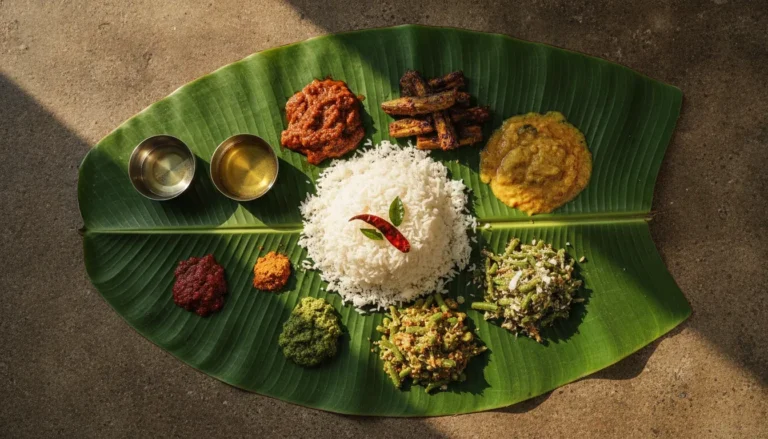
On a banana leaf the order is fixed, and curd rice comes last. You work left to right through the podis and the pickle, the pappu, the pulusu, the rice and ghee, the vegetable curries, and only at the end does the perugu annam arrive, sometimes with a small pour of majjiga charu alongside. It is the course that tells your body the meal is closing.
This is the part of Andhra cooking that a proper meals kitchen understands in its bones. Nandhini has served the full banana-leaf bhojanam across Bengaluru and Mysuru since 1989, and the cooling close is not an afterthought on that leaf, it is the last thing the meal is built towards. You do not order majjiga charu on its own. You arrive at it, at the end of everything else, the way the meal intends.
Frequently Asked Questions
What is perugu annam called in English?
Perugu annam is curd rice: cooked rice mixed with plain, unsweetened curd and a light tempering of mustard seeds, curry leaves and green chilli. In Telugu, perugu means curd and annam means rice. It also goes by daddojanam and, in Tamil, thayir sadam.
What is the meaning of daddojanam?
Daddojanam is the Telugu name for tempered curd rice, often the version served as temple prasadam. It is the same base as perugu annam, cooked rice with curd, but usually given a fuller tempering of mustard, chana dal, ginger and curry leaves.
What is curd rice called in Karnataka?
In Karnataka, curd rice is called mosaranna, from mosaru, the Kannada word for curd. It is the same idea as Andhra perugu annam and Tamil thayir sadam: cooled rice folded through curd with a simple tempering, with small regional differences in the spicing.
What is the difference between majjiga charu and majjiga pulusu?
Majjiga charu is thin and pouring, seasoned buttermilk with a tempering, meant to be spooned over rice. Majjiga pulusu is the fuller version, thickened with gram flour or cooked with vegetables such as bottle gourd, okra or ash gourd.
Is majjiga charu good for summer?
Yes. Majjiga charu is a curd-based dish traditionally made through Andhra summers, valued as a light, cooling counter to the region’s chilli-heavy food and as a way to use curd before it turns. It is eaten with cooled rice, not hot.
What ingredients are in majjiga charu?
Majjiga charu uses whisked sour buttermilk or thinned curd, green chilli, ginger and salt, finished with a tempering of mustard seeds, cumin, curry leaves and asafoetida. Some versions add gram flour to thicken it, and the pulusu version adds vegetables.
Why is curd rice served with cooled rice, not hot?
Hot rice makes curd split into grains and sours it quickly. Cooling the rice first keeps the curd smooth and mild, which is why perugu annam is always mixed with rice that has been spread out and brought down to room temperature before the curd goes in.
Nandhini has cooked Andhra meals in Bengaluru and Mysuru for over three decades, and on that leaf the cool course is where the meal lands. Come find it at the end of a full spread, the way it is meant to be eaten.