Eating out during Navratri in Bangalore is possible, but it works best when you stop thinking in labels and start thinking in rules. Navratri is widely observed as a festival of devotion and, for many people, fasting or food restraint. But not everyone follows the same food discipline. Some avoid only onion and garlic. Some want a lighter satvik-style vegetarian meal. Others follow a stricter vrat pattern that may also exclude grains, legumes, regular salt, and more. That difference matters a lot when you are ordering at a regular restaurant.
That is exactly why this article matters. It is not a promise that every Andhra restaurant can produce a fully vrat-compliant meal on demand. It is a practical guide to help you ask the right questions, avoid the most common assumptions, and order in a way that is respectful to your observance and realistic about how restaurant kitchens work. Nandhini’s own menu already shows that many standard dishes are built around layered masalas, gravies, aromatics, and fixed meal components, which means verification is essential.
Table of Contents
First, know which Navratri lane you are in
The cleanest way to avoid confusion is to identify your own lane before you even open the menu.
Lane 1: No onion, no garlic only
This is the most common restaurant-friendly lane. You are not necessarily fasting in the strict vrat sense. You want vegetarian food, no onion, no garlic, and usually a cleaner, calmer meal. This is often what people mean in casual conversation when they say they want satvik food outside the home, though individual definitions can vary. Sources that explain Navratri fasting rules consistently note that onion and garlic are commonly avoided during the festival.
Lane 2: Vegetarian plus no onion, no garlic, plus milder spice
This lane is especially useful for family outings and office lunches. You want the meal to feel observant, light, and comfortable, not just technically vegetarian. This is where words like “simple,” “less masala,” and “mild” become useful in the restaurant conversation. Nandhini’s own meal content already frames Andhra meals as something you can navigate with controlled spice, curd, and balance rather than just intensity.
Lane 3: Strict vrat rules
This lane is the one that creates the most confusion when people dine out. Strict vrat observance often goes beyond onion and garlic and may exclude grains, pulses, regular table salt, and various standard ingredients depending on family custom and personal practice. If that is your lane, a regular Andhra restaurant menu may not cleanly fit without careful confirmation, and sometimes the better answer is not to force the menu to fit your fast.
What satvik usually means in a restaurant conversation
In a home setting, satvik may be defined with a lot of nuance. In a restaurant conversation, it usually needs to become much simpler. The most practical working meaning is this: vegetarian, no onion, no garlic, not overly spicy, and prepared in a way that feels light rather than heavy. ISKCON-linked material commonly describes sattvic meals as excluding onion and garlic and avoiding overstimulation in flavour, which is a helpful practical frame even though not every diner will follow the same exact standard.
That is also why you should not use the word “satvik” by itself and assume the kitchen knows your exact rules. For one person, satvik means no onion and garlic. For another, it also means no strong masalas. For someone on a full vrat, it may also mean no grains, no regular salt, and no lentils. The word is useful, but only when followed by specifics.
What to ask before you order at an Andhra restaurant
This is the section most readers will actually use, so keep it simple and direct.
Ask these questions before you settle on the dish:
- Does this item contain onion?
- Does it contain garlic?
- Is the gravy or masala base already prepared?
- Can it genuinely be made without onion and garlic, or is that not possible today?
- Which vegetarian options are the simplest?
- Can the spice be kept mild?
- Is curd or plain yogurt available as a support item?
Those questions matter because Nandhini’s current menu includes several dishes that explicitly mention onion, garlic, or spice-heavy bases, while its Andhra veg meals and thali formats also include fixed components such as pappu, sambar, rasam, pickle, chutney, fried chillies, gunpowder, gongura, curd, and sweet. In other words, you cannot assume that “veg” automatically means “Navratri-friendly,” and you also cannot assume that a full thali fits your personal observance without checking the details.
The safest ordering approach during Navratri
If you are eating at an Andhra restaurant during Navratri and want the lowest-risk route, start with the simplest verified vegetarian path, not the most interesting-sounding dish.
That usually means beginning with a veg meal or veg-thali direction, then asking which individual components are suitable for your rule set. Nandhini’s own meal-oriented content shows why this approach works: Andhra meals already come with a built-in structure of rice, dal, sambar, rasam, vegetables, curd, papad, and other accompaniments, which makes them easier to discuss component by component than a single opaque gravy dish.
The next step is to simplify further. If your observance is no onion and garlic only, ask for the least assumption-heavy path. A simpler veg item with clear components is usually safer than a dish with a thick masala base. If your observance also prefers gentler spice, say that clearly. Nandhini’s first-timers article repeatedly treats curd, curd rice, and pacing as practical ways to soften Andhra heat, and that logic is useful here too.
A no-onion-no-garlic ordering script you can actually use
Most people are not stuck because they do not know what to eat. They are stuck because they do not know how to ask.
Here is the most practical dine-in version:
“Hi, we’re eating during Navratri and need vegetarian food without onion and garlic. Could you please suggest the simplest options that genuinely fit that, and also tell us which items cannot be modified?”
This works because it does three things at once. It names the festival context, states the rule clearly, and gives the restaurant permission to say no where needed.
For takeaway or delivery, use this:
“We need a no-onion-no-garlic order for Navratri. Please suggest what is genuinely possible from your kitchen today, ideally mild and simple. Also let us know if the gravy base or masala already contains onion or garlic.”
This version is especially useful because packaged delivery removes your ability to visually double-check as easily, so it is better to be precise up front.
For a family or mixed group order, try this:
“Part of our order is regular, but one section needs vegetarian, no onion, no garlic, and milder spice for Navratri. Please keep those items separate and suggest the safest verified options.”
That separation matters because mixed orders are where confusion happens fastest.
What not to assume
The biggest mistake is assuming that vegetarian automatically means satvik. It does not. Many vegetarian dishes still use onion, garlic, premade bases, or stronger tempering. Nandhini’s menu itself shows vegetarian dishes and thali components that include chutneys, pickles, spice blends, gravies, and prepared elements that may or may not fit your Navratri rules depending on how they are made.
The second mistake is assuming that “less spicy” equals “festival-safe.” It does not. A mild dish can still contain onion and garlic. A vegetarian dish can still fail strict vrat rules. A thali can still include several components that do not match your observance. This is why the most important skill is not choosing the dish name. It is asking the right clarifying question.
The third mistake is assuming every kitchen can modify everything. In practice, many restaurant gravies and masalas are built from prepared bases. If the onion or garlic is already in the base, the answer may reasonably be no. That is not poor service. That is just how kitchen prep works. Nandhini’s menu descriptions already show multiple dishes built around established masalas and fixed preparations, so the article should treat modification as a possibility, not a promise.
What a realistic restaurant-safe Navratri meal looks like
If you are in Lane 1 or Lane 2, a realistic restaurant-safe plan often looks like this:
- one verified vegetarian main or meal base
- one cooling support such as curd, if your observance allows it
- one plain accompaniment
- no stacking of uncertain gravies or multiple side dishes just because the table wants variety
This “less but clearer” approach is usually better than building a large order with five doubtful items. Nandhini’s meals and thalis are already designed around a rhythm of rice, dal, rasam, sambar, vegetables, curd, and a few supportive sides, so the smartest version of Navratri ordering is to simplify that rhythm, not complicate it.
Best fallback strategy if the kitchen cannot support your request
Sometimes the most useful answer from a restaurant is an honest limitation. If the team says a certain gravy cannot be made without onion and garlic, accept that quickly and move to the next best option.
Your fallback could be:
- switch to the simplest verified vegetarian item
- reduce the order size
- add plain curd or yogurt if allowed
- avoid layered sides whose ingredients are unclear
- if you are on a strict vrat, choose a more suitable setting instead of forcing the menu to fit
That last point matters. Medical and lifestyle guidance around Navratri fasting often lists grains, legumes, onions, garlic, and regular salt among commonly avoided items during stricter fasting patterns. A mainstream restaurant menu may simply not be the right fit for that level of restriction.
How to make the meal feel complete without over-ordering
A lot of people over-order during festivals because they are trying to create a sense of occasion. But for Navratri, the better goal is clarity, not abundance.
A complete meal does not have to be large. It has to feel settled. At an Andhra restaurant, that often means choosing one clear meal direction and then protecting it. If the order is supposed to stay no onion and no garlic, do not add speculative extras late in the process. If it is supposed to stay milder, do not throw in a strong side because someone at the table wants “just one spicy thing.”
Nandhini’s current content on first-timer ordering, veg meals, and thali structure supports this exact logic: Andhra food works best when the plate has rhythm and contrast, not when every component is competing at once.
A practical Bangalore mindset for Navratri dining
Bangalore diners often order in groups, mix dine-in with takeaway, and place part of the order for one set of eaters and part for another. That makes precision more important than purity-signalling language. You do not need a long explanation of your beliefs. You need one short, respectful sentence that the staff can act on.
That is why a script-based approach works better than vague requests like “Please make it satvik.” Say what you mean. No onion. No garlic. Mild. Separate packing. Please confirm what is genuinely possible. Those instructions travel well from table service to phone order to delivery.
Final thought
Navratri-friendly eating at an Andhra restaurant is less about finding the perfect label and more about asking the right operational questions. If your lane is no onion and no garlic, be specific. If your lane is satvik-style and milder, say that clearly too. If your lane is a strict vrat, do not assume a standard menu can be stretched to fit it.
That honesty is what makes the meal easier, calmer, and more respectful to the festival. And at a restaurant like Nandhini, where the menu clearly spans fixed meals, layered gravies, veg thalis, curd-based support items, and strongly flavoured Andhra dishes, clarity is not a formality. It is the whole strategy.
FAQs
Is Andhra restaurant food okay during Navratri?
It can be, depending on your food rules. If you only need vegetarian food without onion and garlic, some options may be workable after verification. If you follow strict vrat rules, many regular restaurant items may not fit because stricter fasting often excludes more than just onion and garlic.
Does vegetarian always mean no onion and no garlic?
No. Vegetarian only tells you there is no meat, fish, or egg. It does not confirm the absence of onion, garlic, premade masala, or other ingredients you may be avoiding.
How do I ask for satvik food at a restaurant in Bangalore?
The safest way is to avoid vague wording and say your exact rules: “We need vegetarian food without onion and garlic, mild if possible, and please suggest only items that genuinely fit.”
Can I assume a thali will fit Navratri rules?
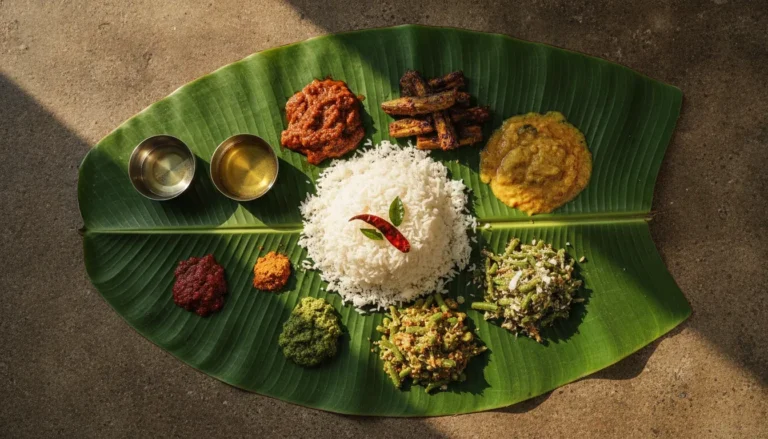
No. Nandhini’s thali content shows that a veg Andhra thali usually includes rice, pappu, sambar, rasam, pachadi, pickle, podi with ghee, appadam, curd, and sweet. Some of these may not fit your rules, so component-level confirmation is important.
What is the difference between satvik and vrat food?
In casual restaurant use, satvik often means vegetarian, no onion, no garlic, and lighter flavouring. Vrat food can be stricter and may also exclude grains, pulses, regular salt, and other standard ingredients, depending on family custom and personal practice.