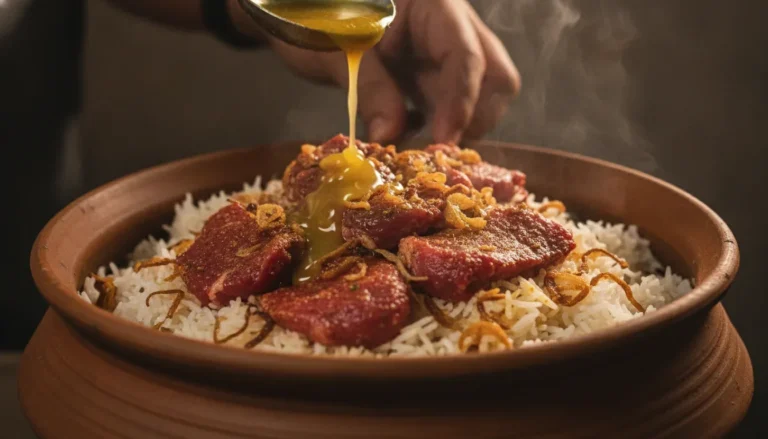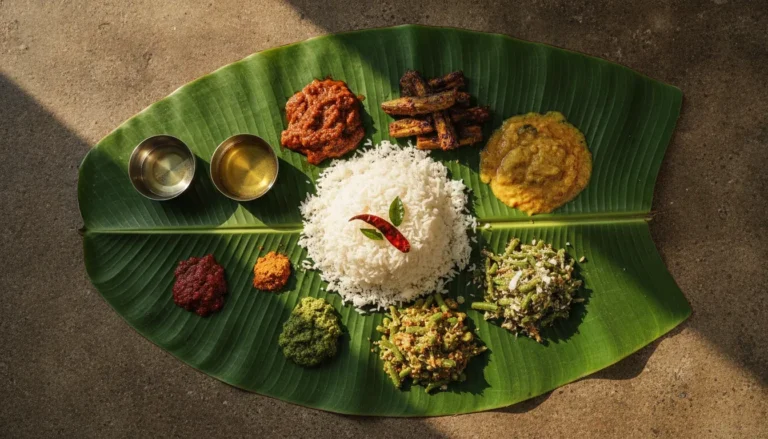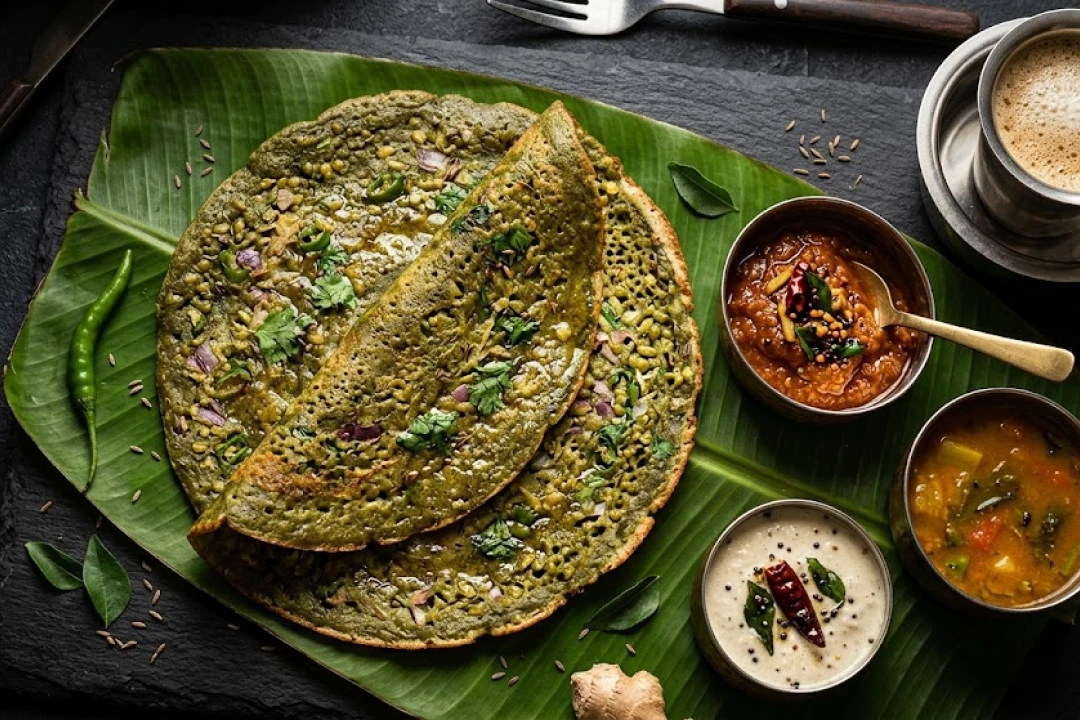
It looks like a dosa. It is not a dosa. Pesarattu is Andhra Pradesh’s green-moong crepe – a thin, savoury pan-bread made from whole green gram, ginger, cumin and green chilli, with no urad and no fermentation. The batter goes from soak to skillet in one morning. The result is greener, denser, earthier than the dosa you know, and it eats best with allam pachadi – a fierce ginger chutney that has its own following in Telugu kitchens.
If you searched pesarattu near mehoping for a clear answer about what to order and where to go in Bangalore, this is the page. We’ll cover what pesarattu actually is, how it differs from a regular dosa, the story behind MLA pesarattu, four spots across the city to try it, and how we serve it at Nandhini Deluxe.
What Pesarattu Actually Is
The name does the heavy lifting. Pesara is the Telugu word for green gram. Attu is the Telugu word for dosa. Put them together and you have green-moong dosa – which is exactly what pesarattu is, with one important caveat: it uses whole green moong (the bean with its skin on), not the split yellow moong used in many fitness-blog recipes. The skin is where the colour and most of the protein come from.
Method is simple. Soak whole green moong overnight. Grind it the next morning with fresh ginger, cumin seeds, green chillies and salt. A small handful of rice goes in for crispness. No urad dal. No fermentation. The batter is ready by the time the pan is hot.
Pesarattu comes from coastal Andhra – Guntur, Vijayawada and the Godavari districts grew up on it as a breakfast staple, the way Karnataka grew up on idli and Tamil Nadu grew up on appam. For the broader picture of the wider Andhra tiffin culture, pesarattu is the headline act. And for the question of where pesarattu fits in the Andhra breakfast scene, it sits at the top of the menu in any Andhra household worth its salt.
Pesarattu vs Regular Dosa
Pesarattu and dosa share a pan and a name. They share almost nothing else. The confusion comes from menus that call pesarattu a “green dosa” or a “moong dosa” – technically accurate, completely misleading. Here is the actual difference.
| Regular Dosa | Pesarattu | |
| Main grain | Fermented rice + urad dal | Whole green moong, no urad |
| Fermentation | 6–8 hours, sometimes overnight | None – batter is fresh-ground |
| Colour | Pale gold to ivory | Olive green to dark green |
| Texture | Lacy, thin, slightly tangy from ferment | Denser, earthier, crisp at the edge |
| Protein per piece | Roughly 2–3 g | Roughly 6–8 g |
| Default pairing | Coconut chutney, sambar | Allam pachadi (ginger chutney) |
Pesarattu does not need overnight planning. The legume base makes it noticeably more protein-forward – roughly 6–8 g against the dosa’s 2–3 g per piece, with the fibre that comes with whole pulses. The flavour is different in kind, not degree: dosa is tangy from fermentation, pesarattu is savoury and slightly grassy from the moong, sharpened by ginger and green chilli in the batter itself.
Adai is the dish people sometimes mistake pesarattu for. Adai uses a mix of three or four lentils plus rice. Pesarattu is moong-only. If a kitchen says its pesarattu is made from chana dal and toor dal too, it isn’t pesarattu.
MLA Pesarattu and the Upma Story
There is one variant of pesarattu that has its own name, its own legend, and most of the search traffic: MLA pesarattu. The story is from 1950s Hyderabad. The canteen at the MLA Quarters – the residential complex where Andhra Pradesh’s Members of the Legislative Assembly stayed during sessions – ran a regular pesarattu on the breakfast menu. One morning, instead of the standard pesarattu, a cook folded a scoop of rava upma into the half-cooked crepe before flipping it, the way a masala dosa hides its potato. It went off-menu, then on-menu, then named after the people who kept ordering it. MLA pesarattu stuck.
So an MLA pesarattu is a pesarattu stuffed with rava upma. Allam pachadi on the side. That is the entire dish, and it has held its shape for seventy years. The Godavari districts and Krishna and Guntur are still its strongholds – ask for one outside the Telugu belt and the kitchen may or may not know what you mean.
It is also, predictably, on the spicier end. The pesarattu itself is mild – the heat comes from the green chillies in the batter and from the allam pachadi alongside, and if you want the longer view on why Andhra cooking is built around chilli the way it is, that’s covered separately. For now: the MLA version isn’t shy. Among the wider list of Andhra signature dishes, it earns its spot.
Where to Find Real Pesarattu in Bangalore
Pesarattu in Bangalore lives in two worlds. There are the dedicated Andhra tiffin spots that open before 8 AM and serve it standalone, paper-thin and fast. And there are the full-meal Andhra restaurants where pesarattu shows up inside the broader spread, served from late morning. Both are legitimate. The right one depends on whether you want pesarattu for breakfast or as part of lunch.
The breakfast tiffin specialists
Babai Tiffins (HSR Layout, with a Sarjapura branch) is the most-cited pesarattu spot on Bangalore food directories. The pesarattu upma is consistent, the allam pachadi has the right ginger-tamarind balance, and the kitchen opens around 8 AM. No-frills seating, cash-friendly, busy on weekends.
HSR High Street has an Andhra tiffins outlet on the same stretch that does a good plain pesarattu – worth the walk if Babai Tiffins is full. Srivari Bhimmas in Yelahanka is the place to ask for MLA pesarattu specifically; they do the upma-stuffed version closer to the Godavari-district style. Tirupati Cafe in Ramamurthy Nagar rounds out the list – older establishment, smaller crowd, the pesarattu comes out crisper and a little browner.
One note worth keeping: the big darshini chains will not do pesarattu well, even if they list it. The batter needs whole moong soaked the night before and ground fresh that morning – a kitchen optimising for speed across thirty dishes can’t run that workflow. If a pesarattu arrives in under ninety seconds at a darshini, it was made from a different batter.
The full Andhra meal version
If you want pesarattu inside an Andhra meal rather than as a standalone tiffin, Nandhini Deluxe is where most regulars end up. The meal experience is different from the tiffin spots above – pesarattu here is one piece of a wider plate that also runs to pappu, pulusu, koora and rice. It is served from late morning, not at 8 AM, and the ambience is restaurant rather than canteen. Different lane, different need.
How to Eat Pesarattu: Allam Pachadi and Beyond
Allam pachadi is the canonical pairing. It is a ginger chutney – fresh ginger, dry red chillies, tamarind, jaggery, salt, sometimes a tempering of mustard and curry leaf. The name carries a small confusion that’s worth clearing up: pachadi in Telugu kitchens refers to fresh chutneys eaten the same day, not the long-aged oil-and-salt pickles called uragaya. For a fuller explainer of the pachadi vs pickle distinction, that’s a separate read.
If you don’t get on with ginger, coconut chutney and peanut chutney are the common alternates – most Andhra tiffin kitchens will have both on the counter. With an MLA pesarattu, the upma is folded inside, so allam pachadi goes on the side as a dip. With a plain pesarattu, some people prefer a smear of allam pachadi straight on the crepe before it’s rolled.
A first-timer note on the heat: allam pachadi runs hotter than it looks. Start with a small dab on the side of the plate, taste it, then go back for more. If you’re new to Andhra spice levels in general, a first-timer’s guide to Andhra spice is the page that takes you through what to expect across the menu.
Pesarattu the Nandhini Way
At Nandhini, pesarattu is part of the Andhra meal – not a standalone tiffin. The kitchen opens at 11:30 AM, which means the breakfast-tiffin window above is something we don’t try to compete with, and shouldn’t pretend to. If you want pesarattu at 7:30 AM, the spots in the previous section are your answer. If you want pesarattu inside a wider Andhra meal at lunch or dinner, that’s the lane we sit in.
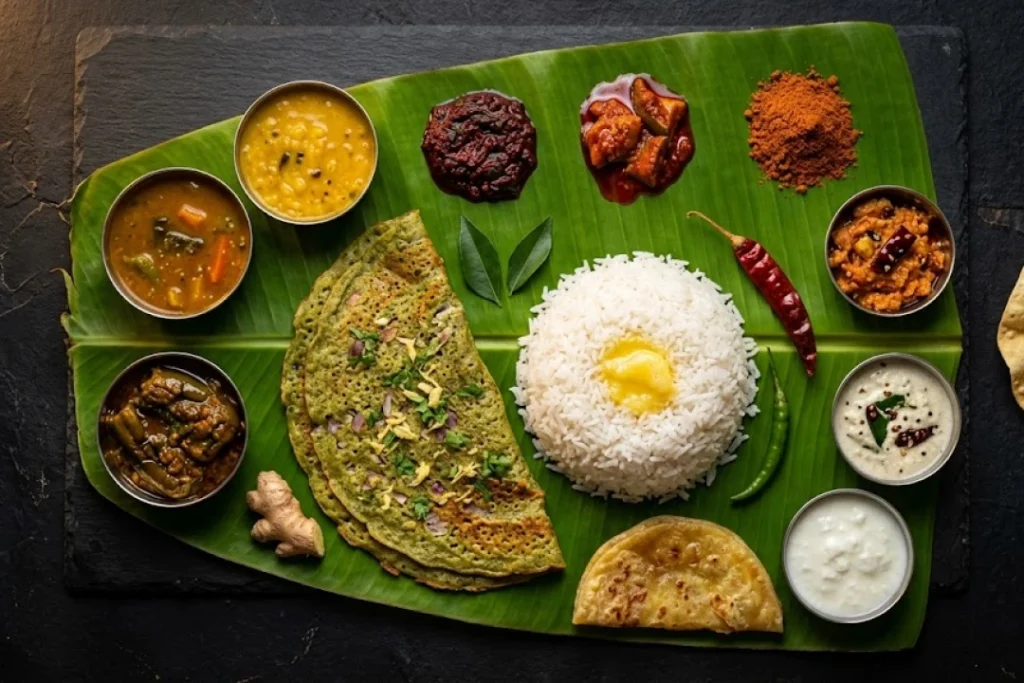
The pesarattu lands on the plate alongside pappu, koora, pulusu, pickle, papad, rice and ghee, with allam pachadi made in-house every morning – ginger ground fresh, tamarind softened, jaggery balanced against dry red chillies from Guntur. The Jayanagar and RT Nagar outlets are most consistent for the dish. We’ve been grinding whole green moong for this same crepe since 1989, which is the only proof point that matters – batter logic is muscle memory, and thirty-seven years of doing the same thing every morning gets you to a version that doesn’t need a chef’s note to explain itself.
Frequently Asked Questions
What is pesarattu?
An Andhra crepe made from whole green moong, ginger, cumin and green chillies. Unlike a regular dosa, it uses no urad dal and no fermentation – the batter goes from soak to skillet in one morning.
What is the difference between pesarattu and dosa?
Regular dosa uses fermented rice and urad dal. Pesarattu uses whole green moong, no urad, no fermentation. Pesarattu is greener, denser and more protein-forward. They share a pan and a name, not a batter.
What is MLA pesarattu?
A pesarattu stuffed with rava upma, served with allam pachadi. The name comes from the MLA Quarters canteen in 1950s Hyderabad, where the upma-stuffed version became an off-menu favourite of the Members of the Legislative Assembly.
Is pesarattu vegetarian?
Yes – and naturally vegan when cooked in oil rather than ghee. The batter contains only whole green moong, ginger, cumin, green chilli, salt and water, sometimes with a small handful of rice. It is gluten-free.
Is pesarattu healthier than dosa?
Pesarattu has roughly 6–8 g of protein per piece against a regular dosa’s 2–3 g, with more fibre from the whole moong. Calorie counts are similar – the swap is mostly about protein.
What is pesarattu served with?
Allam pachadi (ginger chutney) is the traditional pairing, often with a bowl of rava upma alongside. Coconut chutney and peanut chutney are common alternatives. The MLA version folds the upma inside the crepe instead.
Where can I find authentic pesarattu in Bangalore?
Babai Tiffins (HSR, Sarjapura) and Srivari Bhimmas (Yelahanka) do pesarattu well at breakfast hours. Nandhini’s 15+ outlets serve it as part of the full Andhra meal from 11:30 AM onwards.
The Last Word
Pesarattu is one of those dishes that doesn’t survive shortcuts. The whole moong has to be soaked properly. The batter has to be ground that morning. The pan has to be hot enough for the edges to lace and crisp without the centre going dry. Get those three right and you have a crepe that earns the trip. Get any one wrong and you have a flat green pancake. There is no in-between. For the full picture of the Andhra meal experience pesarattu belongs to, that’s the wider read. And to find your nearest Nandhini outlet, the locator has the map.
Thirty-seven years of grinding green moong every morning teaches you to leave the dish alone. Some things just work.