Hold a poothareku up to a window and you can nearly see through it. The wrapper looks like paper and folds like paper, then dissolves the moment it touches your tongue. Pootharekulu (paper sweet) is the odd one out among the famous foods of Andhra Pradesh: a cuisine known across India for its heat also produced the country’s most delicate confection, made from rice-starch sheets in a single village on the Godavari that has been pulling them off hot clay pots for some three hundred years. This page covers what the sweet is, what the name means, where it comes from, how the sheets are made, and why that one village now holds a GI tag for it.
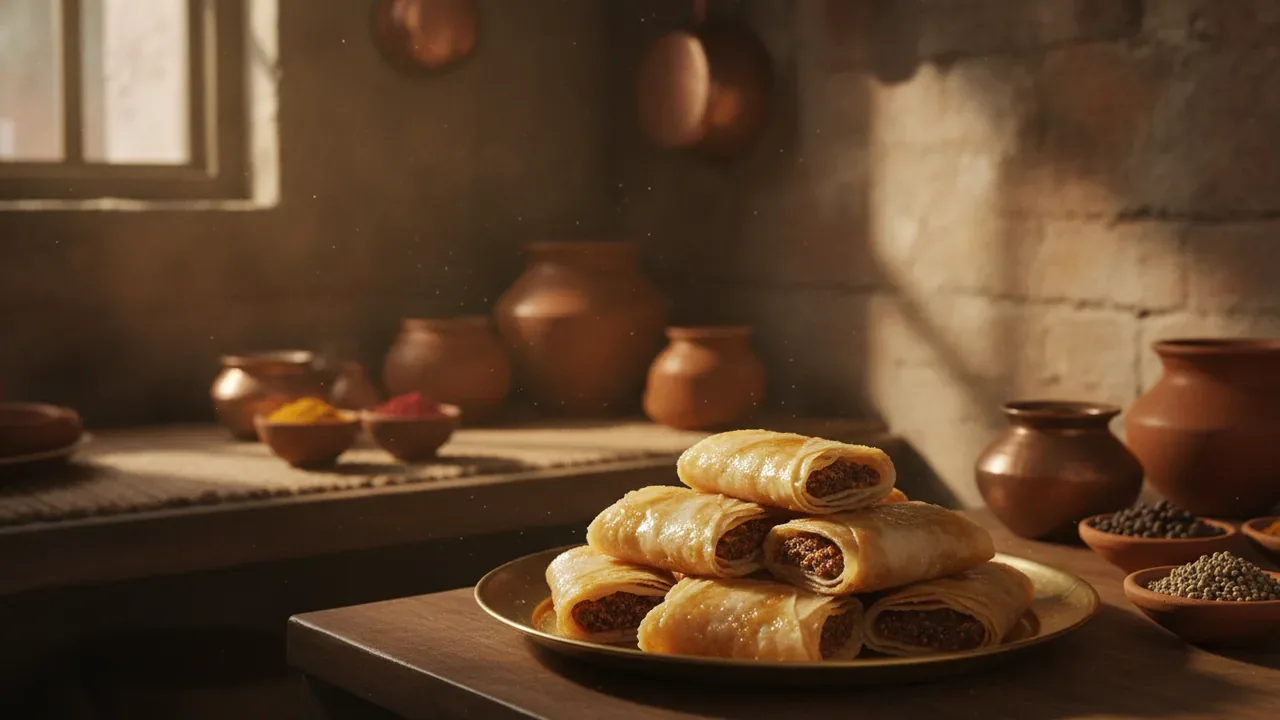
Pootharekulu, called paper sweet in English, is a traditional sweet from Atreyapuram in Andhra Pradesh. Wafer-thin sheets of rice starch, called reku, are brushed with ghee, filled with powdered sugar or bellam (jaggery) and dry fruits, then folded. The Atreyapuram version received a Geographical Indication (GI) tag in June 2023.
Table of Contents
What “pootharekulu” means
The name is a plain description, which is very Telugu of it. Pootha means coating; reku means sheet, rekulu in the plural. Put together, pootharekulu translates as “coated sheets”, which is exactly what the sweet is. One piece is a poothareku. A box of them, the way they are actually bought, is pootharekulu. Pronunciation trips up visitors, but once you know pootha and reku are two words glued together, the rhythm sorts itself out.
In English the sweet goes by paper sweet, sometimes paper mithai, because the wrapper looks and behaves so much like paper that first-timers have been known to peel at it, unsure whether the wrapping comes off before eating. It does not. The sheet is the sweet, dried rice starch rather than anything resembling actual paper, and it melts on contact with the tongue.
You will also meet the spelling putharekulu on shop boards, courier boxes and menus across the Telugu states. Same sweet, same village, same technique; the transliteration just never settled. This page uses both where the trade does.
Atreyapuram and the GI tag
Pootharekulu comes from one place: Atreyapuram, a village near the Godavari in Andhra Pradesh’s Dr. B.R. Ambedkar Konaseema district. Older articles place it in East Godavari, which was accurate until the district was reorganised and renamed in 2022, and a few stray pages put it in Guntur, which was never accurate at all. Konaseema is the address. The geography is not incidental, either: the delta grows the sticky rice the sheets demand, and the village sits close enough to the river that rice, water and generational skill all come from within a few kilometres of each other.
The sweet is said to be about 300 years old, and the origin story the village tells is a good one. A woman spread leftover rice starch across the back of a hot clay pot, and instead of a scrap she got a film so thin it lifted off whole, translucent and intact. Rather than waste it, she folded sugar inside. Whether it happened exactly that way is beside the point; the accident it describes is precisely the technique still in use.
What is beyond folklore is the GI tag. In June 2023, “Atreyapuram Pootharekulu” was granted a Geographical Indication tag, the same class of protection that covers Darjeeling tea and the Tirupati laddu. The Sir Arthur Cotton Atreyapuram Manufacturers Welfare Association had pursued the recognition for more than ten years. A GI tag binds the name to the place: it says the sweet made in Atreyapuram, from local rice by families who have made little else for generations, is a distinct product from any copy assembled elsewhere. For anyone buying a box, it is the nearest thing the sweet has to an authenticity seal, and it is worth looking for on the label.
How pootharekulu is made
Everything hangs on one ingredient and one trick.
The ingredient is jaya biyyam, a sticky rice variety grown around the Godavari delta. Ask in Atreyapuram and you will hear the same line: nobody uses jaya rice for anything except making reku (the sheet). It is too glutinous for everyday cooking, and that glue is the point, because it lets the starch set into a film that peels off in one piece. Swap in an ordinary rice and the sheet tears before it lifts.
The trick is the inverted pot. If you go looking for a pootharekulu recipe, this is the part no home kitchen replicates easily:
- Soak and grind. The rice soaks for several hours, then is ground with water into a batter far thinner than dosa batter, closer to milk.
- Heat the pot upside down. A round earthen pot is inverted over the flame until its curved base is evenly, fiercely hot.
- Swipe once. A clean cloth is dipped into the batter and drawn across the hot base in a single pass. The starch sets on contact.
- Peel the reku. Seconds later the sheet lifts off whole: dry, translucent, light enough to drift on a breath.
- Brush and stack. Each sheet is brushed with ghee and layered, usually two or three sheets to one sweet.
- Fill and fold. Powdered sugar or grated bellam goes in, often with cashew, almond and pistachio, and the stack is folded into a flat parcel or rolled into a log.
There is no baking and no syrup. The sheet is the craft; the filling is assembly. A finished sweet weighs almost nothing, and a full box feels like it is packed with air. Watching a practised maker swipe, peel and stack has more in common with papermaking than with cooking, which is how the English name earned itself. A skilled hand turns out hundreds of unbroken sheets in a morning, and the tear rate is what separates a maker raised on the pot from anyone attempting it for the first time.
Sugar or jaggery: the two fillings
Two fillings dominate, and they are different sweets in the mouth.
The powdered-sugar version is the default in most seller boxes: white, clean, quick to vanish, so what you register is crackle and ghee. Bellam pootharekulu, the jaggery version, is darker and slower, carrying the caramel and faint mineral notes jaggery brings from the cane; it dissolves gradually and the sweetness stays longer. Households tend to split by generation, sugar for the children, bellam for anyone who grew up on it.
| Filling | Taste | Texture | Reach for it when |
| Powdered sugar | Clean, light sweetness | Instant melt, all crackle | Introducing someone to the sweet |
| Bellam (jaggery) | Deep, caramel-edged | Slower dissolve, fuller | You want the older, rounder flavour |
Both arrive plain or layered with dry fruits, and the dry-fruit versions travel better, which is why they fill most of the courier parcels leaving Atreyapuram.
A note on keeping it: pootharekulu hates moisture. Left open, the sheets pull humidity from the air and go leathery within hours, so store the box airtight at room temperature and keep it out of the fridge, where the damp cold kills the crackle faster than any summer. Sealed well, sugar versions hold for two to three weeks; bellam runs a little shorter. Eat it with your hands, whole pieces, over a plate. Nobody manages a poothareku gracefully, and that is part of it.
A sweet woven into celebration
In the Telugu states, pootharekulu is an occasion sweet. Nobody buys a box for an ordinary Tuesday. It belongs to weddings, where it travels in the saare, the trousseau of gifts sent with a bride, and a box of paper sweets in the saare says the family took the trouble to send the real thing. It appears at festivals, housewarmings and temple offerings, and in Atreyapuram they will tell you flatly that no Telugu celebration is complete without it.
Behind the ceremony sits a livelihood. Around 400 families in the village make the sweet, and the division of labour has held for generations: women make the reku, a skill passed hand to hand at the pot, while men handle the packing, the marketing and the courier runs. Demand long ago outgrew the village, and boxes now ship to Telugu households in Hyderabad, Chennai, Mumbai, Pune and Bangalore, cities where a wedding without the paper sweet still feels incomplete to anyone raised on it.
The state knows what it has, too. In August 2018, Andhra Pradesh Tourism commissioned a 10.5-metre poothareku to promote the state’s food, a stunt by any measure, but a revealing one; of everything Andhra cooks, this is the sweet it chose as its calling card.
Where pootharekulu sits in Andhra’s food story
Andhra Pradesh’s reputation runs on heat, and the reputation is earned, but it flattens the picture. The same cuisine behind India’s fiercest pickles also produced its most fragile sweet, and pootharekulu is the proof: a confection with the patience of papermaking, from a food culture the rest of the country associates with fire. Any honest map of Andhra food has to hold both ends.
Nandhini Deluxe has cooked Andhra food in Bengaluru since 1989, growing from a single kitchen at Minerva Circle into the city’s first Andhra restaurant chain, and that long run is a useful vantage point on where a sweet like this sits in the wider spread. The sweet itself belongs to Atreyapuram’s makers, and that is where to buy it. What Nandhini bottles is the other end of the cuisine, the pickles and podis of our pickle & masala range; between the delta’s paper sweet and the pickle jar, you have the two poles of Andhra food, the delicate and the fierce, both made the slow way.
Frequently Asked Questions
What is pootharekulu called in English?
Pootharekulu is known in English as “paper sweet” or “paper mithai”, named for its wafer-thin, paper-like wrapping. The wrapper is a dried sheet of rice starch, not actual paper, which melts in the mouth despite its papery appearance.
What is putharekulu made of?
It is made from a sticky local rice variety (jaya), ground into a thin batter and formed into wafer-thin sheets called reku. The sheets are brushed with ghee and filled with powdered sugar or bellam (jaggery) and dry fruits, then folded.
What is pootharekulu famous for?
Pootharekulu is famous for its almost translucent, paper-thin texture and its home in Atreyapuram, Andhra Pradesh, where about 400 families make it by hand. It is a fixture at Telugu weddings and festivals, and its Atreyapuram version holds a GI tag.
What is the meaning of pootharekulu?
The name is Telugu: pootha means coating and reku (plural rekulu) means sheet, so pootharekulu literally means “coated sheet”. The singular form is poothareku. The name describes exactly how the sweet is built: thin coated sheets, layered and folded.
Is pootharekulu made with sugar or jaggery?
Both versions exist. The classic filling uses powdered sugar, while the jaggery version, called bellam pootharekulu, has a deeper, caramel-like note. Many makers offer dry-fruit variants of each, with cashew, almond and pistachio layered inside the sheets.