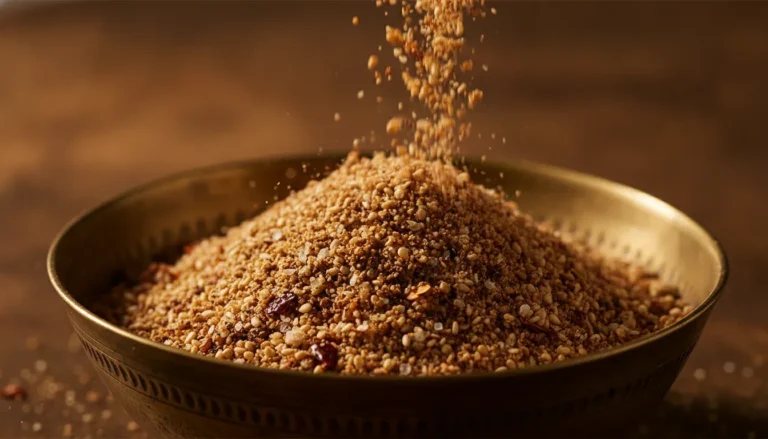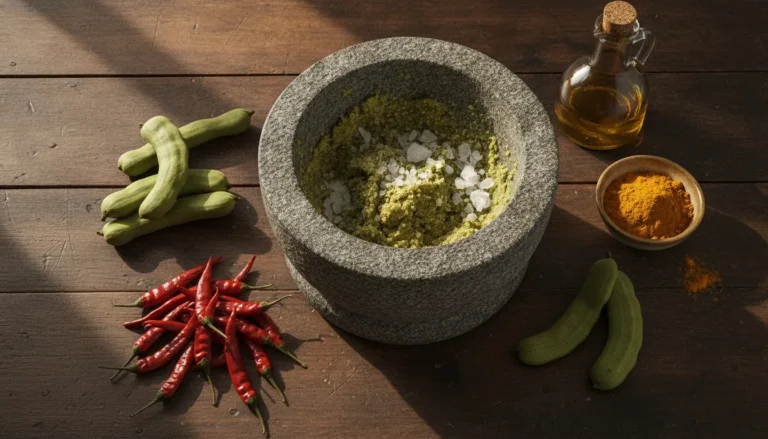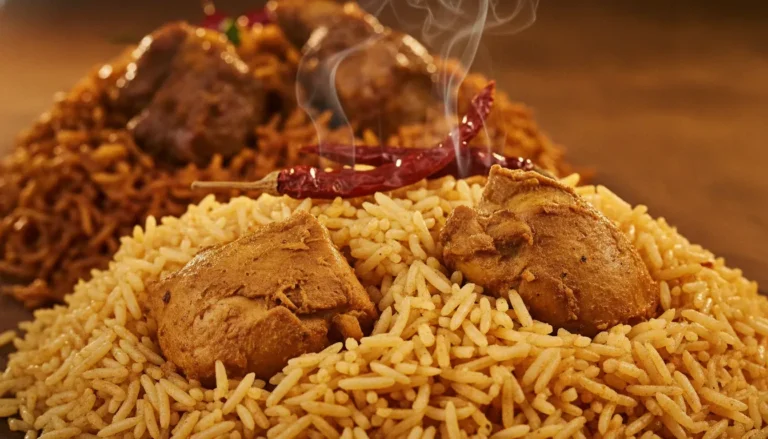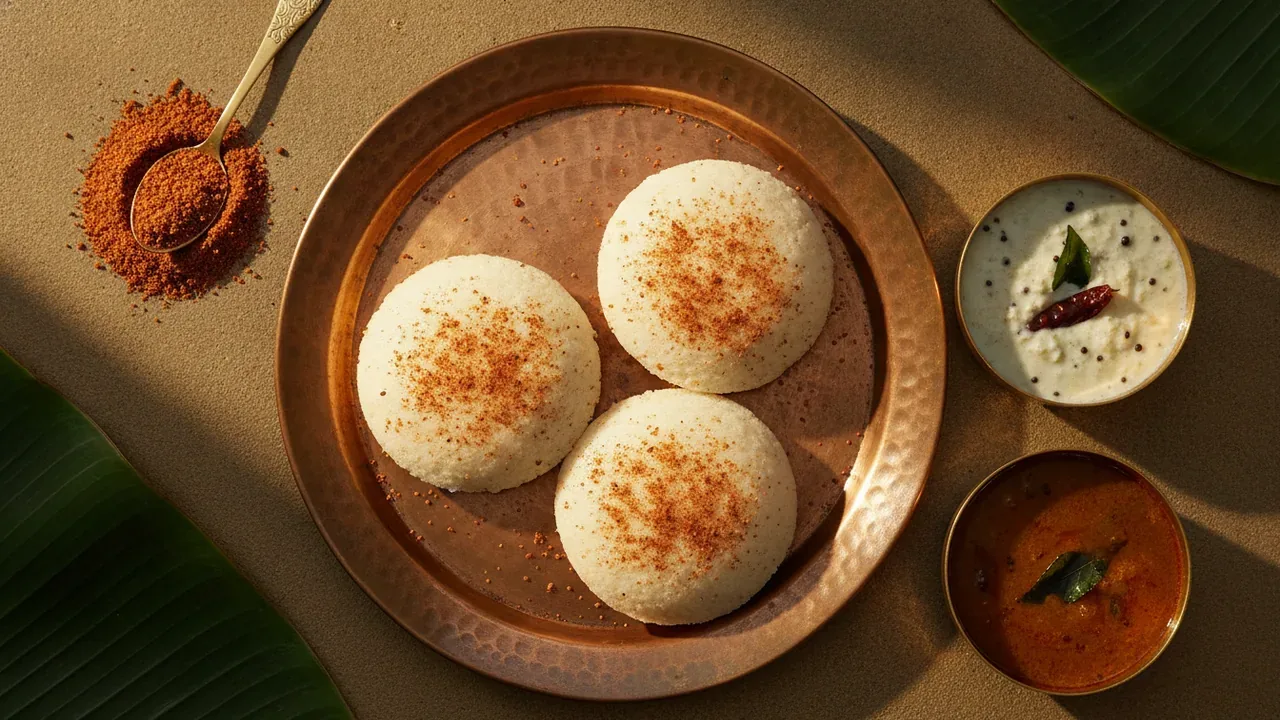
Ask for idli podi in a Tamil kitchen and you get one thing: a rust-red powder of chillies, sesame and lentils, dusted over hot idlis with a slick of gingelly oil. Ask in an Andhra kitchen and the answer splits in two. There is milagai podi (chilli-and-lentil powder), the fiery one most people mean when they say gun powder, and there is kobbari podi (coconut podi), nuttier and softer, the one recipe blogs treat as an afterthought. Same breakfast, two different powders. Most pages online only cover the first. This is the Andhra reading of idli podi: what the two powders are, how Guntur heat changes them, and how to make and keep both without them turning damp by the weekend.
Idli podi is a dry condiment of roasted lentils, dried red chillies and sesame, ground coarse and served over idli and dosa with sesame oil or ghee. Tamil kitchens call it milagai podi; the informal English name is gun powder. Andhra versions lean on Guntur chillies, and split into chilli-based milagai podi and coconut-based kobbari podi.
Table of Contents
The naming knot: gun powder, milagai podi and karam podi
Half the confusion around idli podi is a naming problem. The recipe blogs call it milagai podi. Amazon listings call it gun powder. Your Andhra neighbour might say karam podi and mean something else entirely. Untangling this matters, because two of those names point at the same breakfast powder and one points at a different plate.
Milagai podi and idli podi are the same thing. Milagai is Tamil for chilli, podi is powder, and the condiment is the roasted chilli-and-lentil blend you spoon over idli. Gun powder is just the English nickname it picked up, earned by the red heat rather than by any change in recipe.
You will also meet it under other labels. Some kitchens sell it as chutney podi (or chutney pudi), older Tamil households call it molaga podi, and in parts of the south you will simply hear thool. Different names, the same roasted chilli-and-lentil idea.
Karam podi (kandi podi) is where the road forks. Karam means heat in Telugu, and Andhra karam podi is the fierier gunpowder built on toor dal (kandi pappu) and a heavier hand of Guntur chillies, eaten with rice and a pool of ghee, not dusted over breakfast idlis. It is hotter, coarser and made for lunch. If you came looking for that rice-and-ghee firecracker, that is a separate powder with its own rules. Idli podi is the gentler morning cousin, and it is what the rest of this page is about.
Milagai podi vs kobbari podi: the Andhra split
Here is the part almost no recipe page reaches. In Andhra kitchens, idli podi is not one powder but a pair, and the two are built on opposite ideas. Milagai podi is chilli-led: dried red chillies, urad dal (minappappu), chana dal (senagapappu) and sesame, roasted dark and ground coarse, sharp and hot on the tongue. Kobbari podi is coconut-led: the same lentil-and-chilli base carried by roasted dried coconut (endu kobbari), which rounds the heat off and turns the whole thing nutty and mellow.
They behave differently on the plate and in the jar. Milagai podi is the one you reach for when you want a slap of heat with your dosa. Kobbari podi is the gentler one, the powder you give a child, or spoon over curd rice when the day has already been too spicy. Coconut also carries oil, so kobbari podi eats richer but keeps for less time. Told apart by eye, milagai podi runs darker and redder, while kobbari podi is paler and flecked with toasted coconut. Plenty of homes label the two jars, if only so a guest knows which one bites.
Milagai podi vs kobbari podi
| Milagai podi | Kobbari podi | |
|---|---|---|
| Base flavour | Chilli-forward, sharp | Coconut-forward, nutty |
| Key ingredient | Dried red chillies and sesame | Roasted dried coconut (endu kobbari) |
| Heat | High, Guntur-led | Mild to medium |
| Texture | Dry, coarse, gritty | Softer, slightly oily |
| Served with | Idli, dosa, uttapam | Idli, curd rice, milder plates |
| Shelf life | One to three months | Shorter (coconut carries oil) |
Most Andhra homes keep both jars side by side and choose by the morning’s mood. If you only ever make one, make milagai podi first. Once that roast is in your hands, kobbari podi is a short step sideways.
The Guntur heat question
Why does Andhra idli podi taste different from the Tamil version people grew up on? One word: Guntur. The dried red chillies grown around Guntur in coastal Andhra are the heat engine of the whole cuisine, sitting around 30,000 to 50,000 on the Scoville scale, well above the gentle 1,000 to 2,000 of a Kashmiri chilli. Use them whole in a podi and the powder bites back.
But heat is only half the job. A good idli podi wants colour as much as fire, and pure Guntur chilli can run muddy and harsh. Andhra cooks who know what they are doing blend: Guntur for the heat, and a handful of Byadgi or Kashmiri chillies for the deep red colour and a softer background warmth. The ratio is a matter of taste. Two parts Guntur to one part Byadgi gives a podi that looks generous and eats hot without stripping the roof of your mouth. Go all Guntur only if your table already eats Andhra-hot as a matter of habit.
If Guntur chillies are hard to find where you are, the Sannam (S4) variety they are often sold as travels well, and any dark, properly hot dried chilli with a Byadgi blend for colour gets you close. What you are chasing is that specific coastal-Andhra sharpness, not raw heat on its own.
How to make milagai podi
Milagai podi rewards patience at the pan more than anything else. The single mistake that ruins a batch is rushing the roast or grinding while the mix is still warm. Here is the order that works, built for a jar that keeps.
A working ratio for a medium batch: 1 cup urad dal, half a cup chana dal, 15 to 20 dried red chillies (mostly Guntur, a few Byadgi for colour), 2 tablespoons sesame seeds, a teaspoon of cumin, a small piece of asafoetida (inguva / hing), 12 to 15 curry leaves (karivepaku), and salt to taste.
- Dry-roast the chana dal first, on low, until it turns golden and smells nutty. It is the hardest lentil, so it goes in first. Move it to a plate.
- Roast the urad dal (minappappu) the same way, until pale gold, then add it to the plate.
- Roast the dried red chillies with the curry leaves until the chillies darken a shade and turn crisp. Watch the pan closely; burnt chilli turns the whole podi bitter.
- Roast the sesame seeds last and quickly, just until they start to pop. Sesame burns in seconds.
- Cool everything completely. This step is not optional. Warm ingredients release oil in the grinder and the podi clumps.
- Grind coarse, not fine. You want a gritty powder that still shows flecks of chilli and dal, not a paste. Pulse rather than run the machine.
- Add the salt and asafoetida at the end and pulse once more to fold them through.
Store it the moment it cools to room temperature. A properly dry-roasted, coarsely ground milagai podi holds its heat and its texture for weeks. If a batch of yours has ever gone damp or bitter, one of these seven steps was the culprit, usually the roast or the cooling.
How to make kobbari podi
Kobbari podi is milagai podi with a coconut heart, and once you have the roast above in your hands it takes ten extra minutes. The base is the same roasted lentils and chillies. The change is the coconut, and how you treat it.
Use dried coconut (endu kobbari), not fresh. Fresh coconut carries water, and water in a podi is the fast road to mould. Grate or slice the dried coconut and dry-roast it gently on low until it turns pale gold and smells toasty. Let it cool with the rest of the roast.
Then grind the roasted lentils, chillies and sesame as before, add the roasted coconut, and pulse the lot together coarse. Some cooks finish kobbari podi with a few drops of sesame oil (nuvvula nune) worked in, which deepens the flavour but shortens the shelf life further. Keep the coconut ratio sensible, roughly a third of the total by volume. Too much and the podi turns soft and greasy within a fortnight, however carefully you roasted it.
Keeping it fresh
The commonest complaint about home idli podi is that it goes damp, clumps, or turns bitter after a couple of weeks. Every one of those problems comes down to moisture, and moisture creeps in from three places.
First, an incomplete roast. Lentils pulled off the heat too soon keep a little water inside them, and that water leaks into the powder over days. Roast until nutty and dry, every time. Second, grinding while warm. Heat pushes the sesame and coconut to release oil, and oil is what makes a podi cake into lumps. Cool the roast fully before it goes near the grinder. Third, the wet spoon. A single dip with a spoon that touched hot idli or curd will seed a jar with damp, and eventually mould.
Store idli podi in a clean, dry, airtight jar and always serve with a dry spoon. Milagai podi keeps one to three months at room temperature. Kobbari podi keeps less, because coconut carries oil. In humid weather, or for a jar you will finish slowly, the fridge buys you months more.
If a jar has only just begun to feel soft, you can usually rescue it. Tip the podi into a dry pan, warm it gently over low heat for a minute or two to drive the moisture off, then cool it fully and re-seal. Once mould has set in, though, the batch is done, so start again.
How Andhra eats it
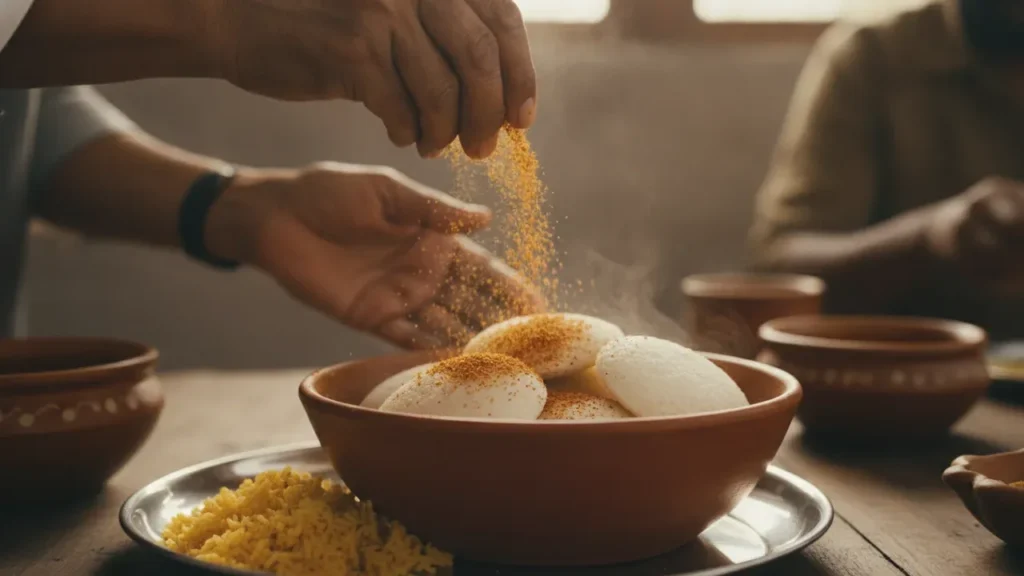
On an Andhra table, idli podi is rarely served dry. The classic way is a spoon of the powder on the plate, a good pour of sesame oil (nuvvula nune) or warm ghee over it, mixed to a loose paste, and the idli or dosa dragged through. It goes on uttapam, into the first bite of a fresh dosa, over curd rice to wake it up, and it turns leftover idlis into podi idli: idlis tossed in oil and podi and pan-crisped, which is arguably better than the original.
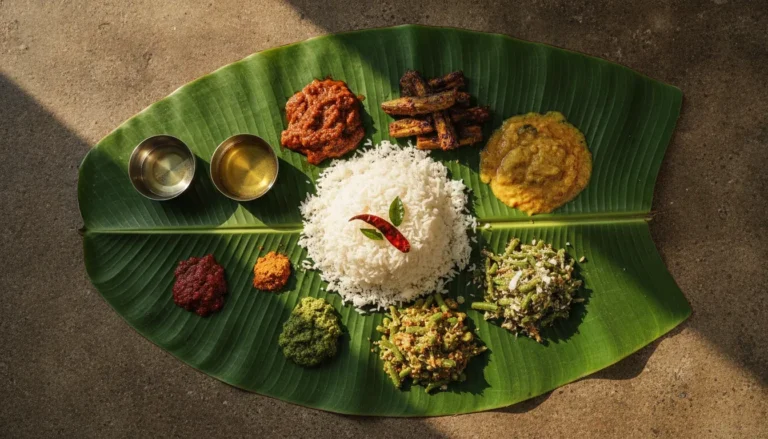
Podi shows up on a full Andhra banana-leaf bhojanam too, a small heap in the corner of the leaf beside the pickle and the ghee. It is one of the quiet workhorses of the spread, never the star, but the thing people miss when it is missing.
If you would rather buy than roast, that is a fair choice, and a good jar is worth finding. Nandhini serves podi with its banana-leaf bhojanam across its Bengaluru and Mysuru kitchens every day, and its retail arm, World of Nandhini, bottles Andhra podis and pickles for taking home. Whether you make your own or take a jar back with the week’s shopping, the test is the same: a coarse, dry, Guntur-honest powder that bites and keeps.
Frequently Asked Questions
Are idli podi and milagai podi the same?
Yes. Milagai is Tamil for chilli and podi means powder, so milagai podi is the chilli-and-lentil idli podi. Andhra kitchens use the name idli podi for the same breakfast condiment, often built on Guntur chillies for extra heat.
What is kobbari podi?
Kobbari podi is the coconut-forward cousin of idli podi, built around roasted dried coconut with lentils and chillies. It is milder and nuttier than milagai podi, and because coconut carries oil, it keeps for a shorter time.
Is idli podi the same as karam podi or gun powder?
They overlap but differ. Idli podi is the milder breakfast side for idli and dosa. Karam podi (kandi podi) is the fierier Guntur gunpowder eaten with rice and ghee. It is hotter, and built for a different plate.
How long does idli podi last?
Kept in an airtight jar at room temperature and served with a dry spoon, milagai podi keeps for one to three months. Coconut-based kobbari podi keeps a shorter time. Refrigerate either for long storage or humid weather.
Why does my idli podi turn moist or spoil?
Moisture is almost always the cause: under-roasted lentils that still hold water, grinding while the roast is warm so the sesame releases oil, or a wet serving spoon. Dry-roast fully, cool completely before grinding, and always serve with a dry spoon.
What is idli podi in English?
It is usually called a dry chutney powder or spiced lentil powder, a coarse blend of roasted lentils, dried red chillies and sesame served with idli and dosa. Gun powder is a common informal English name for it.