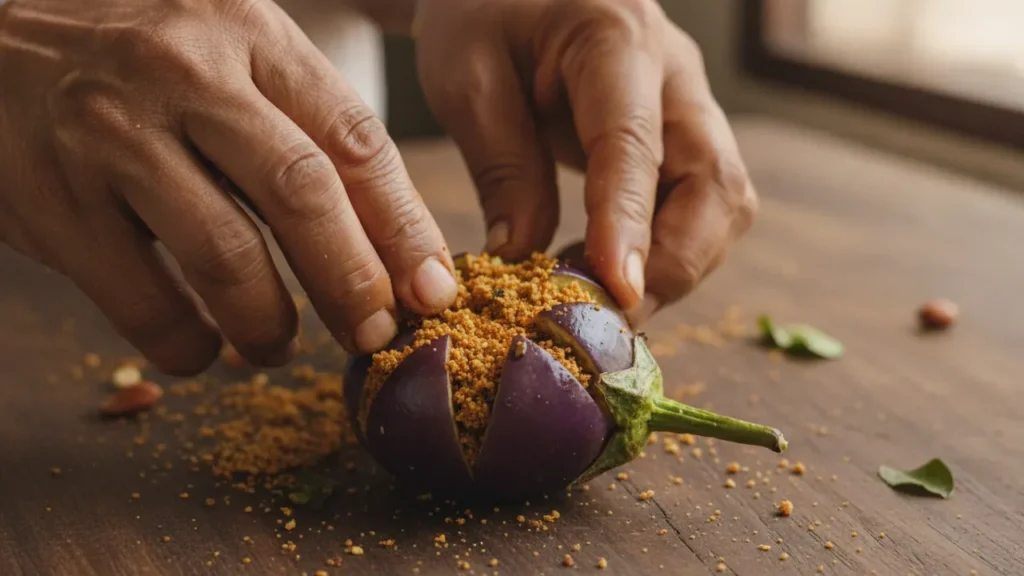
Slit a small brinjal into a cross, keep the stalk end joined, and pack the four petals with a coarse roasted-peanut masala. That is gutti vankaya before it meets the pan, and it is why the dish holds its shape while the inside turns to a spoonable softness. Search the name, though, and you land in a muddle. One page calls it a dry fry, the next a tamarind gravy, a third mixes it up with bagara baingan. All three are describing something real. None of them lay it out cleanly.
Gutti vankaya is a stuffed-brinjal curry from Andhra Pradesh and Telangana. Small tender brinjals are slit and filled with a dry-roasted peanut, sesame and coconut masala, then cooked with tamarind, curry leaves and Guntur chilli until the oil separates and the brinjals collapse into the sauce.
Table of Contents
Gutti vankaya, meaning and English name
Break the name down and it tells you how to cook the dish. Vankaya is the Telugu word for brinjal, the small round or oval aubergine sold across Indian markets. Gutti means whole, or stuffed, the sense of a thing kept intact and filled rather than chopped. Put the two together and gutti vankaya is a whole brinjal packed with masala, sometimes translated more loosely as a bouquet of brinjal for the way the slit vegetable opens like petals.
In English it goes by stuffed brinjal curry, or stuffed eggplant curry if you are reading an American recipe, or stuffed aubergine curry in British usage. The vegetable is the same; only the name shifts by country. So if a recipe promises stuffed baby eggplant in a peanut sauce, it is describing this dish under a borrowed name.
Where gutti vankaya comes from
Gutti vankaya belongs to the Telugu-speaking south, which since the 2014 division means two states: Andhra Pradesh and Telangana. Ask three cooks from three districts how they make it and you will get three answers, because the masala shifts with the land it comes from. The differences are real, and worth knowing before you decide which version you are after.
- Rayalaseema: drier and hotter, built on Guntur chillies (30,000–50,000 SHU) and plenty of groundnut, with the tamarind kept light so it reads as a spiced fry.
- Coastal (Kosta) Andhra: saucier, with more tamarind, a touch of jaggery to round the sourness, and coconut in the masala; the version that eats best with rice and ghee.
- Telangana: more sesame and a darker roast, with a thinner gravy that edges closest to its Hyderabadi cousin, bagara baingan.
- Guntur karam: not a region but a heat setting, a red-chilli-forward version cooked across both states wherever the household likes it fierce.
None of these is the correct one. They are the same idea, tuned to a place. The version most Andhra restaurants outside the state settle on is the coastal peanut-tamarind gravy, because it holds and reheats without drying out, and it is also the one most first-time eaters picture when they think of gutti vankaya. Knowing which you have eaten, or want to cook, is the difference between chasing the wrong recipe and finding the plate you remember.
One brinjal, three dishes
The dry-or-gravy argument online exists because gutti vankaya is not one dish. It is a method, the stuffing, worked three ways.
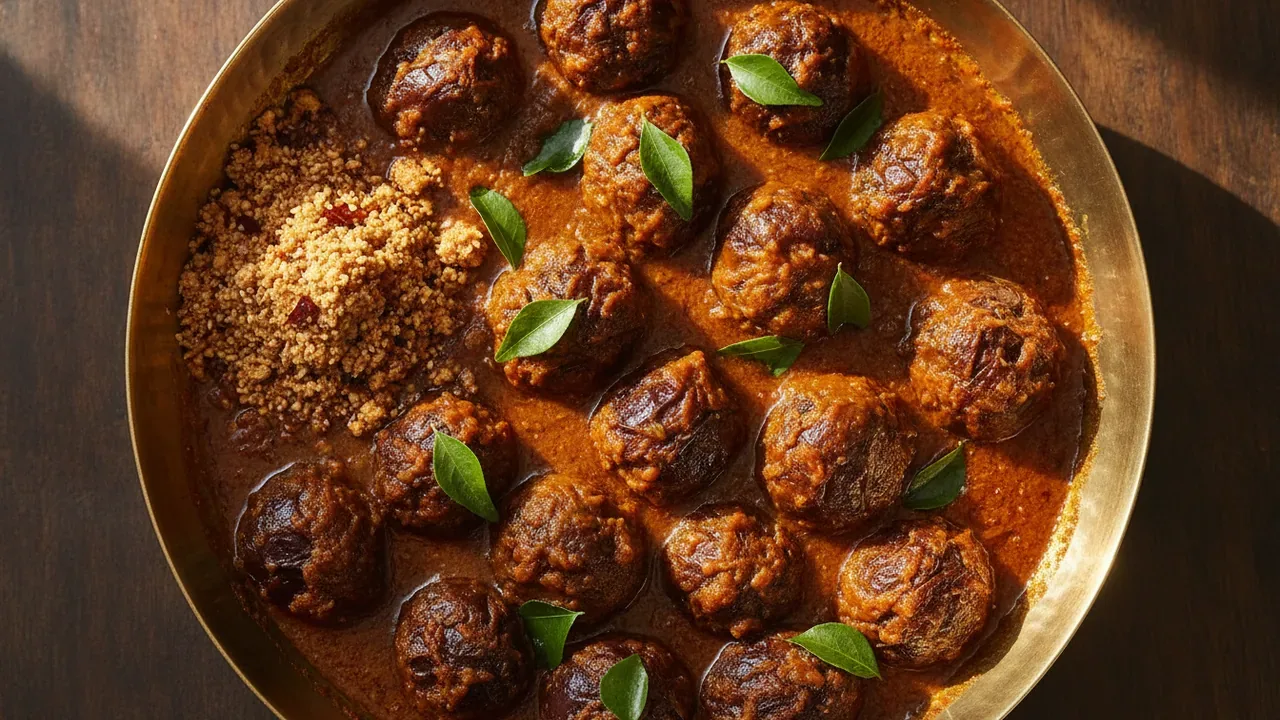
Gutti vankaya kura is the gravy. The stuffed brinjals simmer in a tamarind-and-peanut sauce until the oil rises and they slump into it. This is the version most people mean by gutti vankaya, and the one built for a rice plate.
Gutti vankaya vepudu (dry fry) skips most of the liquid. The brinjals cook down in oil with the same masala until the edges catch and crisp, closer to a roast than a curry. Rayalaseema kitchens favour it, and it travels well on a tiffin plate.
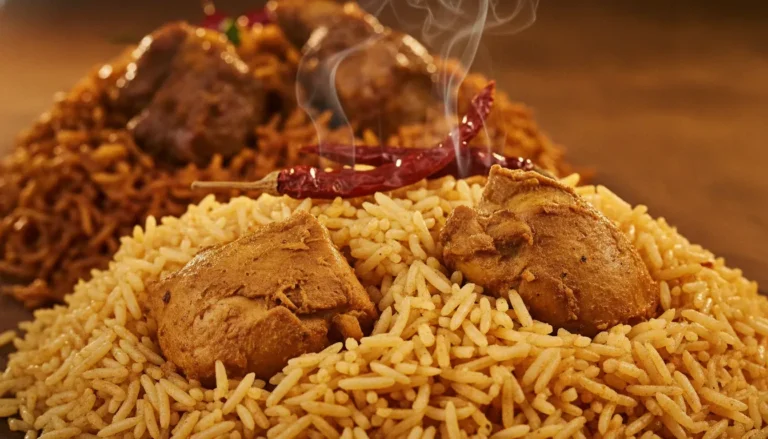
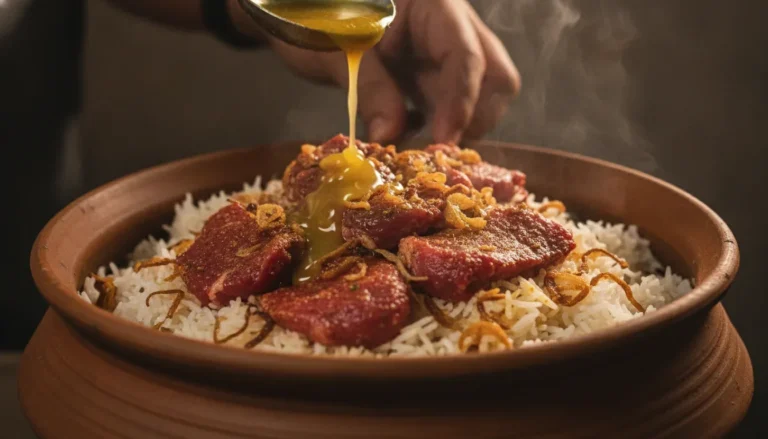
Then the brinjal masala goes into rice. Gutti vankaya pulao and gutti vankaya biryani cook the stuffed pieces into the pot so the grains carry the peanut-sesame flavour. The pulao keeps it gentle and everyday; the biryani layers the stuffed brinjals with dum-cooked rice for a heavier, festive plate. Neither replaces the kura, but both are real dishes, and the reason people search for them by name.
So when one recipe insists gutti vankaya is dry and another swears it is a gravy, both are right. They are cooking different members of one family. Decide which you want before you start, because the tamarind quantity changes everything after that.
Gutti vankaya vs bagara baingan vs bharwa baingan
Four dishes across India start the same way: a whole brinjal, slit and stuffed. What goes inside, and what happens next, is where they part. The confusion is worst between gutti vankaya and bagara baingan, because both come from the Telugu region and both use peanuts and sesame. The stuffing and the sauce are what separate them.
| Dish | Origin | Dry or gravy | Masala base | Heat |
|---|---|---|---|---|
| Gutti vankaya kura | Andhra Pradesh / Telangana | Stuffed; dry fry or peanut-tamarind gravy | Roasted peanut, sesame, coconut, coriander | Medium to high |
| Bagara baingan | Hyderabad (Telangana) | Gravy; brinjals usually not stuffed | Peanut, sesame, coconut, ginger-garlic, thinner sauce | Medium |
| Bharwa baingan | North India | Stuffed; mostly dry | Dry spice mix, no peanut base, mustard and fennel notes | Mild to medium |
| Ennegayi (enne badanekai) | Karnataka | Stuffed; thick gravy | Peanut, coconut, jaggery, sesame, tamarind | Med, sweeter |
The tell is simple. If the brinjal is stuffed and the sauce is built on roasted peanuts and tamarind, you are eating gutti vankaya. If the brinjals sit whole and unstuffed in a thinner, richer sauce, that is bagara baingan, the dish that turns up beside Hyderabadi biryani. Bharwa baingan drops the peanut base for a dry North Indian spice rub. One vegetable, four grammars.
What goes into gutti vankaya
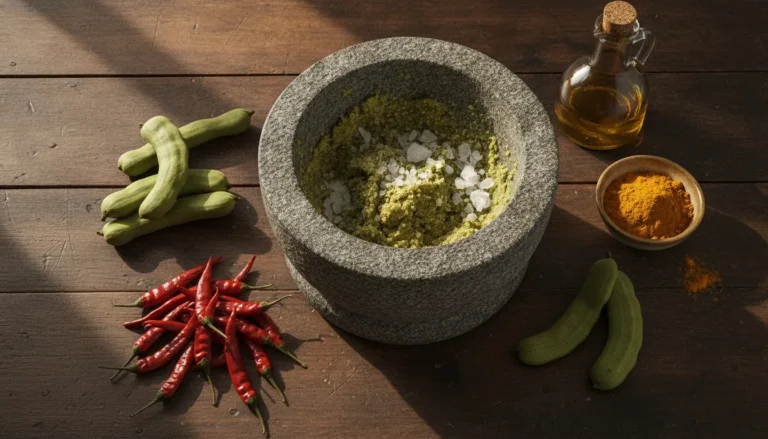
Start with the brinjal. The dish wants small, tender, deep-purple ones, no longer than a thumb, with tight glossy skin and a fresh green cap. Larger brinjals turn seedy and bitter and will not hold the stuffing. Green-tinged or streaked baby brinjals work too, and cook a shade faster for their thinner skin, but the deep-purple ones give the sweeter flesh the masala wants. Slit each one into a cross from the base, leaving the stalk end joined, so it opens into four petals and closes back around the masala.
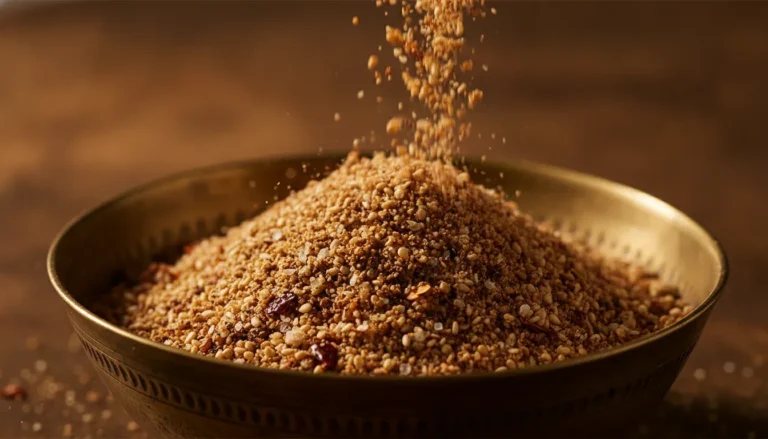
The masala is dry-roasted, then ground coarse: groundnuts (peanuts) for body, sesame (nuvvulu) for a nutty depth, dry coconut for a rounder sweetness, plus coriander seed, cumin and dried red chilli. Roasting is the step home cooks rush and restaurants do not. A proper roast is the line between a masala that tastes of raw peanut and one that tastes of gutti vankaya.
Tamarind (chintapandu) brings the sour spine, and a small knob of jaggery keeps it from turning sharp. Curry leaves, mustard seed and a tempering of oil finish the pot. There is no cream, no onion-tomato base and no dairy, so gutti vankaya is naturally vegan and gluten-free, and the peanuts and sesame carry real plant protein. The oil is not shy, mind, so it sits better as a considered portion on the plate than as a light bite.
How it comes together
- Dry-roast the peanuts, sesame, coconut, coriander, cumin and red chillies, then grind to a coarse powder with salt.
- Slit the brinjals into a cross, keeping the stalk end intact, and press the masala into each one.
- Temper mustard seed and curry leaves in oil, then lay the stuffed brinjals in to brown gently.
- Add any leftover masala, tamarind extract and a little water, cover, and cook on a low flame.
- Simmer until the brinjals are soft and the oil separates and rises to the top, the sign that the curry is done.
- Stir in the jaggery to balance the sour, rest for a few minutes off the heat, and serve.
Getting it right
Two things go wrong with gutti vankaya, and both have plain causes.
Bitterness comes from the brinjal, not the spice. Old, over-seeded vegetables carry it, and so does cut flesh left too long to oxidise. Pick young brinjals, slit them just before cooking, and a short salt rest draws out the sharp juices. Some cooks drop the cut brinjals into salted water while the masala roasts, which does the same job.
The other marker is the oil. Andhra cooks watch for the moment it separates and pools at the edge of the pan. Until it does, the masala is still raw and the gravy tastes flat; once it does, the dish is finished. Rushing past that point is the most common home mistake.
Heat here is a choice, not a default. Guntur chillies run 30,000 to 50,000 on the Scoville scale, hot but not punishing, and the tamarind and jaggery exist to hold that heat in balance. A kitchen making the same curry every day leans on that balance for consistency, which is why a good restaurant gutti vankaya tastes steadier than a first attempt at home: the roast, the heat and the sour land on the same point each time. That steadiness is the quiet case for eating gutti vankaya where it is cooked in volume: the brinjal is never underdone, the oil has always broken, and the tamarind is judged rather than guessed.
How gutti vankaya is served
Gutti vankaya is a rice dish before it is anything else. The classic pairing is steamed rice with a spoon of ghee, which carries the peanut-sesame masala and softens the heat. Chapati or roti suits the drier vepudu. In the interior, jonna rotta, the jowar millet flatbread, is the traditional partner, and it turns the meal into something closer to everyday Rayalaseema eating than restaurant fare.
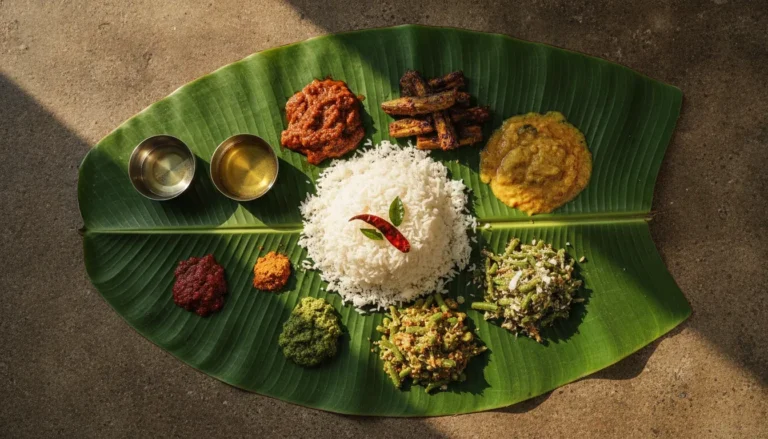
On a full Andhra banana-leaf meal (bhojanam), gutti vankaya takes its place within the spread rather than starring in it: pappu on one side, a pickle such as avakaya, pulihora, rice, rasam and curd, each in its own spot on the leaf. The stuffed brinjal is the veg curry that gives the plate its weight, the one people go quiet over halfway through the meal.
This is the vegetarian tradition Nandhini Deluxe has cooked in Bengaluru since 1989, as the pioneering Andhra restaurant chain, now across 22 outlets. An Andhra veg curry like gutti vankaya sits squarely in the kind of banana-leaf vegetarian meal the kitchen is built around: peanut, tamarind, curry leaf and a Guntur edge, cooked the way an Andhra home would, held steady the way a restaurant has to. For the whole vegetarian spread rather than the single dish, the Andhra veg meals guide is the place to start.
Frequently Asked Questions
What is gutti vankaya?
Gutti vankaya is a stuffed-brinjal curry from Andhra Pradesh and Telangana. Small tender brinjals are slit and packed with a roasted peanut, sesame and coconut masala, then cooked with tamarind and curry leaves until the oil separates and the brinjals turn soft.
What is gutti vankaya called in English?
In English it is stuffed brinjal curry, or stuffed eggplant or aubergine curry. Gutti means whole or stuffed in Telugu and vankaya means brinjal, so the name describes a whole brinjal filled with spiced masala rather than a chopped one.
What region is gutti vankaya from?
It belongs to Andhra Pradesh and Telangana, with distinct Rayalaseema, coastal and Guntur styles. Rayalaseema versions run drier and hotter with Guntur chillies, while coastal versions lean on tamarind and a peanut-sesame-coconut gravy. Telangana cooks favour more sesame and a darker roast.
Is gutti vankaya healthy?
Yes, in moderation. It is vegetarian, and naturally vegan and gluten-free. Peanuts and sesame add plant protein and healthy fats, though the masala uses a fair amount of oil, so portion size matters. Paired with rice or millet rotta it makes a balanced plate.
What is the difference between gutti vankaya and bagara baingan?
Gutti vankaya is stuffed, built on a roasted peanut-sesame-coconut masala, and often drier. Bagara baingan is a Hyderabadi gravy from Telangana in which whole brinjals sit in a thinner sauce and are usually not stuffed. The stuffing and the sauce are the tell.
How is gutti vankaya served?
It is eaten with steamed rice and ghee, chapati, or jonna rotta millet bread. On an Andhra banana-leaf meal it sits alongside pappu, pickle, rasam and rice. In Andhra restaurants it is a common vegetarian curry served beside biryani.