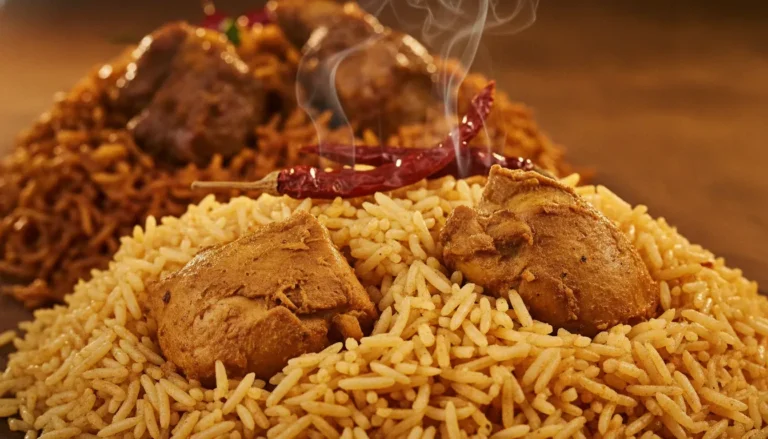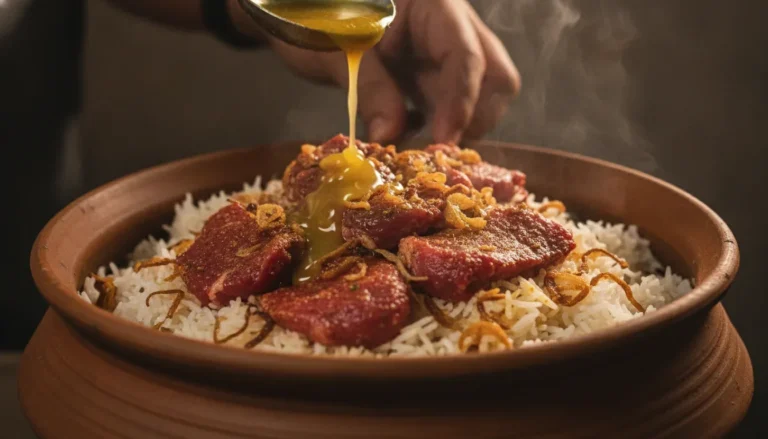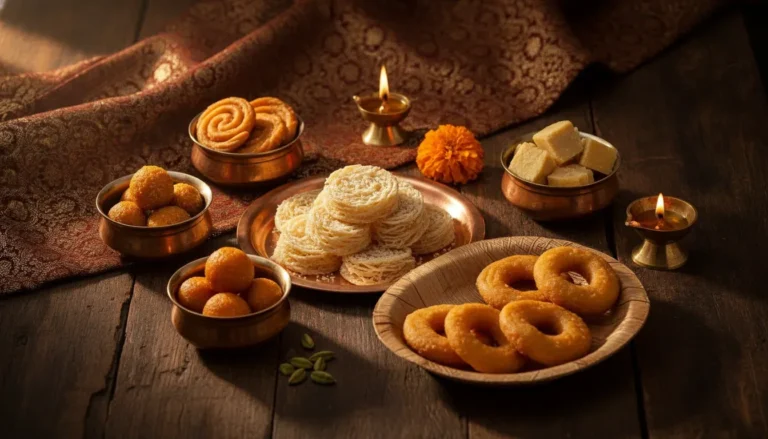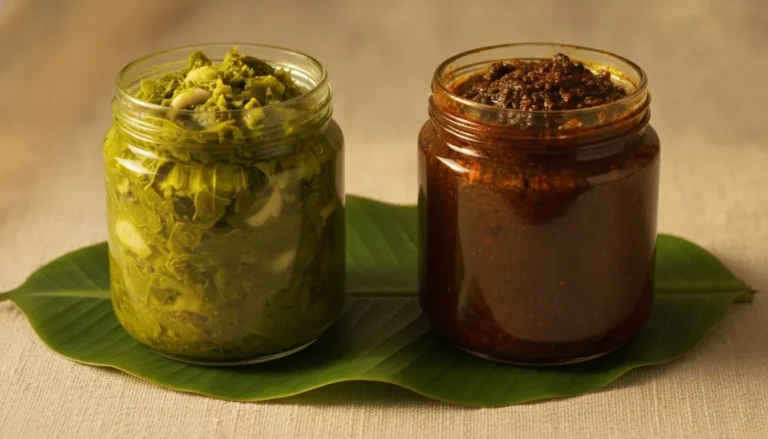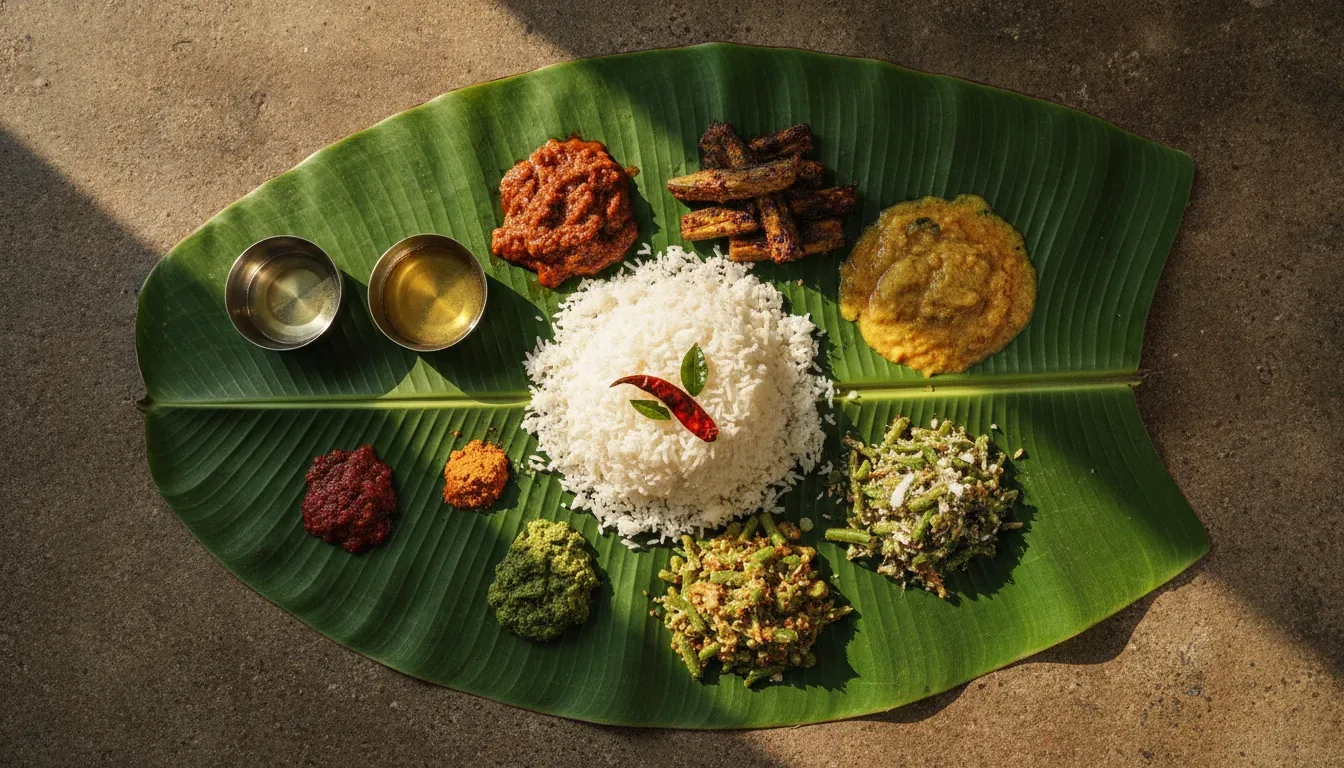
Sit down to a proper Andhra Veg Curries and the rice arrives almost bare, ringed by small mounds of colour: a dark okra fry on one side, a pale tamarind stew on the other, a spoon of stuffed brinjal, a scoop of dal thick with yellow cucumber. Mix the first handful and it makes sense. The heat lands, the tamarind cuts, and the plain rice turns into the point of the meal.
That spread is one corner of the famous foods of Andhra Pradesh, and every mound on it is an Andhra veg curry of some kind. This page maps the lot. Not what to order in a rush, but what each dish is, how it is cooked, and what makes an ordinary vegetable taste unmistakably Telugu.
| An Andhra veg curry is a vegetable dish from Andhra Pradesh built on three signatures: the sourness of tamarind (chintapandu), the heat of Guntur red chillies, and body from sesame, peanut or coconut. It takes four main forms: koora (curry), vepudu (dry fry), pulusu (tamarind stew) and pappu (dal cooked with a vegetable). |
Table of Contents
What makes a curry Andhra style
Most people meet Andhra food through its reputation for chilli and leave it there. Very spicy, they say, and move on. That misses what actually holds these curries together. Heat is only one of three levers.
The Guntur red chilli brings it, roughly 30,000 to 40,000 on the Scoville scale, sharper and fruitier than a Kashmiri chilli and used with far less apology. Against that heat sits tamarind, the sour spine of nearly every Andhra kitchen. Then comes the third element outside cooks tend to forget: body. Roasted sesame (nuvvulu), peanut, coconut or a spoon of karam podi (spice powder) gives the gravy weight and a nutty finish, so the chilli has something to hold onto.
Take any one of those three away and the dish stops tasting Andhra. Heat with no sourness reads as Chettinad or plain South Indian. Get the balance right and you can taste the state in a single mouthful.
The four ways Andhra cooks a vegetable
Ask for a curry list in Telugu and you are really asking about method, because the same vegetable becomes a different dish depending on how it is treated. This is the distinction recipe roundups tend to blur, and it is the most useful thing to hold in your head.
A koora (or kura) is the everyday vegetable curry, semi-gravy, the thing that sits next to rice as the main veg dish. A vepudu is dry, stir-fried hard until the edges catch and go a little roasted; this is where okra and cluster beans shine. A pulusu is the tamarind stew, loose and tangy, poured over rice rather than spooned. And a pappu is dal cooked with a vegetable folded through it, thick and quietly filling, the backbone of a Telugu meal. A fifth, iguru, sits between koora and vepudu: thicker than a curry, moister than a fry.
Knowing which form a vegetable takes tells you almost everything about the dish before you taste it. Dosakaya, firm and sour, goes into pappu and pulusu. Bendakaya, prone to sliminess, wants a vepudu. The table below lays the four out.
| Style (Telugu) | What it is | Texture | Example dish |
| Koora / Kura | Vegetable curry, the main veg dish | Semi-gravy | Gutti vankaya koora |
| Vepudu | Dry stir-fry, roasted-edge finish | Dry | Bendakaya vepudu |
| Pulusu | Tamarind-based tangy stew | Loose, saucy | Dosakaya pulusu |
| Pappu | Dal cooked with a vegetable | Thick | Dosakaya pappu |
Dosakaya (yellow cucumber) curries
Dosakaya is the fat, pale-yellow cucumber that turns up in Telugu kitchens and confuses everyone else. It is not the salad cucumber you slice raw. It is firmer, a little sour on its own, and it holds its shape through a long simmer, which is exactly why Andhra cooks stew it rather than fry it.
The two dishes it belongs in are dosakaya pappu and dosakaya pulusu. In the pappu, diced dosakaya cooks down with toor dal (kandi pappu), green chilli and a tempering of mustard, cumin and curry leaves. The cucumber’s own tartness plays against the soft dal, so the dish needs almost no extra sourness. The pulusu goes the other way: here tamarind leads, dosakaya soaks up the tang, and a small lump of jaggery rounds the sour edge into something you could eat by the bowl.
There is a reason you rarely see a dry dosakaya fry. Cut into a hot pan, it weeps water and goes to mush before it can crisp. Stewed slowly, that same water becomes an asset, carrying the tamarind and chilli into every piece. The sour-sweet balance is the whole game with a dosakaya curry: enough jaggery to soften the tamarind, never enough to make it a sweet dish.
Bendakaya (okra) curries
Bendakaya (okra, or lady’s finger) is the vegetable everyone loves and half of everyone ruins. Cook it wrong and you get a slippery, sticky mess. Cook it the Andhra way, as a bendakaya vepudu, and you get something with a dry, almost roasted bite.
The trick is respect for moisture. Wipe the okra dry before you cut it, because water is what wakes the sliminess. Cut it, then cook it dry and largely undisturbed over a fairly high flame, giving it room in the pan rather than crowding it into a steaming heap. A tadka (popu) of mustard, urad dal, dried Guntur chilli and curry leaves goes in, and a pinch of tamarind or a little tomato late in the cooking adds acid that tightens the texture further. Stir too often and you drag the slime out; leave it alone and the edges catch and crisp.
There is a saucier cousin worth knowing, a bendakaya-tomato curry where the okra simmers in a light tomato and onion base. It is gentler, better with roti than rice. But the vepudu is the one Telugu households make on a weeknight, and the one that earns okra its place on the plate.
Beans: chikkudukaya and goruchikkudu
Two beans carry the Telugu winter, and they are easy to mix up. Chikkudukaya are the flat, broad beans, wide and slightly sweet. Goruchikkudu are cluster beans, thin and knobbly, with a faint bitterness that some cooks prize and others temper.
The classic treatment is a koora, and the pairing that makes it is chana dal. Soaked senagapappu (chana dal) goes in with the chopped beans, giving a chikkudukaya curry a firm, mildly nutty backbone that plain beans lack on their own. A Guntur-chilli tempering, a little grated coconut or a spoon of sesame powder, and you have a dish that is substantial without any onion or tomato gravy at all.
Chikkudukaya takes well to this because the broad pods stay meaty through cooking. Goruchikkudu needs a firmer hand: blanch it first if the bitterness bothers you, then cook it down until the cluster beans lose their raw edge. Both reward slow heat. Rushed, they stay squeaky and grassy; given time with the dal and the popu, they turn tender and savoury, the kind of everyday curry that never makes a menu photo but shows up on every home plate.
More everyday Andhra veg curries
Beyond the headline three, a working Andhra kitchen runs a long bench of everyday Andhra veg curries, most named for the vegetable and cooked as a koora, vepudu or pulusu. A few worth knowing:
- Beerakaya (ridge gourd): a light koora or a pappu, mild and cooling, often finished with sesame or peanut. A beerakaya curry is the calm after a run of heat.
- Vankaya (brinjal): the base for gutti vankaya, small brinjals stuffed with a peanut, sesame and chilli paste, the best-known Andhra veg dish of all.
- Sorakaya (bottle gourd): gentle and watery, usually a pappu or a light kura, the dish you reach for when the plate has grown too fierce.
- Dondakaya (ivy gourd): a firm little gourd made into a crunchy vepudu, sometimes with peanuts.
- Potlakaya (snake gourd): mild and spongy, classically paired with sesame in a koora.
- Kanda (yam): dense and starchy, fried into a spiced vepudu with a crisp edge.
- Bacchali (Malabar spinach): a soft green, cooked into a pappu or a tangy pulusu.
Two of these earn deep-dives of their own. Gutti vankaya, the stuffed-brinjal koora, is a dish worth learning on its own terms, and the pappu-and-pulusu pairing sits at the heart of how Telugu meals are built. Here they are simply part of the bench, the rotation a household cooks through across a week.
Traditional pairings and the spice balance
The old pairings are not random. Telugu cooking has a quiet logic about which vegetable meets which fat and which souring agent, worked out over generations of home kitchens. Snake gourd goes with sesame, the nutty paste giving a watery gourd something to stand on. Raw mango turns up with brinjal in early summer, its green sourness standing in for tamarind. Bottle gourd and yam get moong or toor dal to carry them. None of it is written down; it is simply how a household cooks.
The other half of the logic is heat management. Andhra food is hot, but a good meal never lets the chilli run unchecked. Jaggery softens the sour-hot edge of a pulusu. A cooling dish is always somewhere on the plate: perugu annam (curd rice) or a bowl of majjiga charu (spiced buttermilk), there to reset the palate between spoons of the fiercer curries. That contrast, hot against cool and sour against sweet, is the real grammar of a Telugu veg spread, and it is why one curry alone never tells the whole story.
Where these curries come from a working Andhra kitchen
Most of what is written about Andhra veg curries comes from recipe sites. It is worth hearing it from a kitchen that cooks them to order. Nandhini Deluxe has served Andhra food in Bengaluru since 1989, and several of the dishes on this page run on its banana-leaf veg bhojanam every day: gutti vankaya koora, bendakaya vepudu, a dal or a pulusu depending on the vegetable that came in fresh.
Cooking them at that volume, across 20 outlets in Bengaluru and two in Mysuru, settles the small questions a recipe cannot: how much tamarind before a pulusu turns flat, when okra has caught enough to come off the heat. If you want to see how these curries sit together on a full vegetarian plate rather than one dish at a time, that is what the veg meal is built to show.
Frequently Asked Questions
What is Andhra-style curry?
An Andhra-style curry is a vegetable dish from Andhra Pradesh defined by tamarind sourness, the heat of Guntur red chillies, and a body of sesame, peanut or coconut. It appears as koora (curry), vepudu (dry fry), pulusu (tamarind stew) or pappu (dal with vegetable).
Which vegetable curry is famous in Andhra Pradesh?
Gutti vankaya koora, small brinjals stuffed with a peanut, sesame and chilli paste, is the best known. Other everyday favourites include bendakaya vepudu (okra fry), dosakaya pappu (yellow-cucumber dal), beerakaya (ridge gourd) and chikkudukaya (broad beans) curries.
What are the most popular Telugu vegetable curries?
Common Telugu veg curries include gutti vankaya (brinjal), bendakaya (okra), dosakaya (yellow cucumber), beerakaya (ridge gourd), sorakaya (bottle gourd), dondakaya (ivy gourd) and chikkudukaya (beans), cooked as a koora, vepudu, pulusu or pappu depending on the vegetable.
What is dosakaya, and how is it cooked?
Dosakaya is Andhra yellow cucumber. Because it is firm and slightly sour, it is usually simmered into dosakaya pappu (dal) or dosakaya pulusu (tamarind stew) rather than fried, where its tang balances the lentils and chilli.
How do you keep bendakaya (okra) curry from turning slimy?
Cook the okra dry and undisturbed over higher heat as a vepudu, add a little tamarind or tomato for acidity, and avoid crowding the pan. Wiping the okra dry before you cut it also keeps a bendakaya curry crisp rather than sticky.
What are chikkudukaya and goruchikkudu?
Both are Telugu beans: chikkudukaya are flat broad beans and goruchikkudu are cluster beans. They are cooked as a koora, often with chana dal (senagapappu) and a Guntur-chilli tempering, which gives a firm, mildly nutty curry with almost no gravy.
If you are in Bengaluru or Mysuru, Nandhini has cooked these curries on a banana leaf since 1989. The best way to understand an Andhra veg spread is still to sit in front of one.