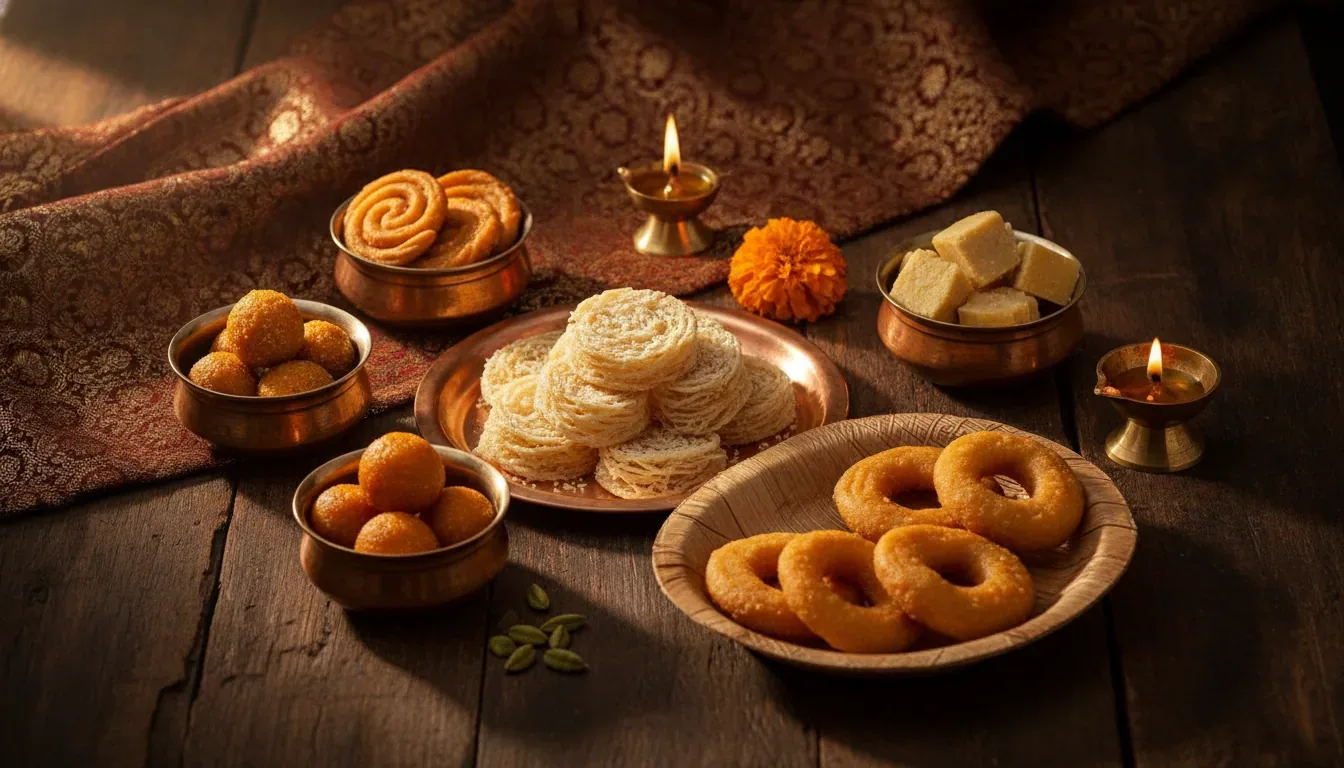
The most famous of all Andhra sweets is not for sale. The Tirupati laddu leaves the Tirumala temple as prasadam, handed to pilgrims rather than sold over a counter, and it has carried a Geographical Indication since 2009. The temple kitchen turns out roughly 280,000 a day, with capacity for more than 800,000 when the crowds swell. You cannot walk into a shop and buy one.
Everything else on the list, you can. The difficulty is naming it. Most people reach a search box holding a picture and not a word: the paper-thin sheet, the fried jaggery disc, the little urad dal ball that dissolves on the tongue. This guide names all twelve, says what each is made of and when it is eaten, marks the three that hold a GI tag, and points you to the towns that still make the real thing. Sweets sit inside the wider spread of famous foods of Andhra Pradesh, and they earn their own map here because the names alone defeat most searches.
Andhra sweets are the traditional sweets of Andhra Pradesh and Telugu homes, built mainly on bellam (jaggery), rice flour and ghee rather than the milk and sugar of north Indian mithai. Most are tied to festivals, above all Sankranti, and many belong to specific towns along the Godavari and Krishna districts.
Table of Contents
Which Andhra sweet are you thinking of?
Telugu sweet names do not travel well in the memory, so people describe the sweet instead of naming it. The most searched of these descriptions is the paper one, the sweet that looks as if it was wrapped in a sheet of edible paper. Others go hunting for a jaggery disc, a lentil ball, a stuffed flatbread. If you are holding a picture and reaching for a word, start here. The full entry for each sweet waits a little further down.
| If you are describing it as… | It is called… |
|---|---|
| A paper-thin, translucent sheet you can almost see through | Pootharekulu |
| A sweet wrapped in edible rice paper | Pootharekulu |
| A soft stuffed flatbread with a sweet lentil filling | Bobbatlu (bakshalu) |
| A small round ball of urad dal that melts in the mouth | Sunnundalu |
| A fried disc of rice flour and jaggery | Ariselu |
| A dark slab of dried mango, chewy like leather | Mamidi thandra |
| A crisp shell-shaped sweet coated in jaggery | Bellam gavvalu |
| A flaky, layered, syrup-soaked finger | Kakinada kaja |
| A deep-fried half-moon with a sweet coconut filling | Kajjikayalu |
| A dense, fudge-like milk sweet | Palakova |
The 12 famous Andhra sweets
Pootharekulu (పూతరేకులు)
Pootharekulu (paper sweet) is the one people describe most and name least. Wafer-thin films of rice batter are lifted off an upturned clay pot, dried, then folded with ghee and a filling of jaggery or powdered sugar. It comes from Atreyapuram in the Godavari belt and holds a GI tag. The full account of the jaya biyyam batter and the clay-pot film sits on the dedicated pootharekulu page.
Bobbatlu (బొబ్బట్లు)
Bobbatlu (sweet stuffed flatbread), also called bakshalu, is a soft griddled bread stuffed with a sweetened filling of chana dal and jaggery, or sometimes coconut. Across the south it answers to other names too, holige and obbattu and puran poli, though the Andhra version keeps its own balance. It belongs to Ugadi and to wedding feasts. The alias set and the dough method are covered on the bobbatlu page.
Ariselu (అరిసెలు)
Ariselu (rice and jaggery disc) is the Sankranti sweet, a soft fried round of soaked rice flour and molten jaggery, often pressed with sesame. Getting it right is a test of the jaggery syrup, since the dough splits in the oil if the consistency is off. It is a home and sweet-shop sweet made for the harvest, not a restaurant dish. Why it splits, and how to stop it, is set out in full on the ariselu page.
Sunnundalu (సున్నుండలు)
Sunnundalu (urad dal laddu) is a small round ball of roasted urad dal, ground fine and bound with jaggery or sugar and a generous amount of ghee. Once the dal is roasted and powdered it needs no further cooking, which makes it a fixture in Telugu homes and a common Sankranti offering. It keeps for weeks and is one of the first sweets a Telugu child learns to roll by hand.
Bandar laddu (బందరు లడ్డు)
Bandar laddu takes its name from Bandar, the old name for Machilipatnam in Krishna district. It is a coarse-grained laddu of gram flour boondi, sugar, ghee and dry fruit, with a texture rougher and nuttier than the smooth Bombay laddu. Registered with a GI tag in 2017, it is the sweet the town is known for, sold by long-running shops rather than made much at home.
Kakinada kaja (కాజా)
Kakinada kaja is a layered, deep-fried pastry, rolled and folded so it fries into crisp sheets, then soaked in sugar syrup until the middle turns soft while the edges stay brittle. The Kakinada version is the plumper, juicier one. Bite it and the syrup should run. It is a coastal Godavari speciality, sold fresh by the town’s sweet shops and carried away by the boxful.
Tapeswaram madatha kaja
Tapeswaram madatha kaja is the kaja’s drier, architectural cousin from the village of Tapeswaram. Madatha means folded, and the sweet is built from many thin folded layers that hold their shape and crunch rather than collapsing into syrup. It keeps far longer than the Kakinada style, which is why it travels so well as a gift, and the texture tells the two kajas apart at once.
Kajjikayalu (కజ్జికాయలు)
Kajjikayalu (sweet fried dumpling) is a half-moon of thin wheat pastry crimped shut around a filling of dry coconut, roasted gram, jaggery or sugar and cardamom, then deep-fried until golden. It is made in large batches for Diwali and Sankranti, when a house will turn out dozens at a sitting. Elsewhere in India the same shape goes by gujiya, though the Andhra filling leans drier and more coconut-forward.
Bellam gavvalu (బెల్లం గవ్వలు)
Bellam gavvalu are small shell-shaped fritters, ridged like a cowrie, deep-fried and then tossed in a jaggery coating that sets to a thin crust. Bellam is jaggery and gavva is a shell, so the name is a plain description of what you get. They are a Sankranti and Diwali snack sweet, made to be kept in a tin and eaten by the handful over the festival days.
Poornam boorelu (పూర్ణం బూరెలు)
Poornam boorelu are dumplings of sweetened chana dal and jaggery, wrapped in a rice-and-urad batter and deep-fried so the outside puffs crisp while the filling stays soft. Poornam is the filling, boorelu the casing. They are offered at Vinayaka Chavithi and Atla Taddi, and are best eaten warm, before the coating loses its crackle.
Mamidi thandra (మామిడి తాండ్ర)
Mamidi thandra (mango leather) is ripe mango pulp, sweetened and sun-dried in thin layers built up over days into a dark, chewy slab. It belongs to the summer, when the crop is heavy, and it is more a preserve than a shop sweet. Slices keep for months and hold the flavour of the fruit long after the season ends, which makes it a favourite thing to post to relatives abroad.
Palakova (పాలకోవా)
Palakova (milk fudge) is one of the few Andhra sweets that leans on milk rather than jaggery and rice. Milk is reduced slowly, with sugar, until it thickens to a soft, grainy fudge, the version from around Bhimavaram best known. Rich and short-lived, it should be eaten within a couple of days, which is the trade-off for its softness.
The three Andhra sweets with a GI tag
A Geographical Indication is a legal mark that ties a product to the place that makes it, the way Champagne ties to its region. For a sweet, a GI certifies that the genuine article comes from a named town and is made in a particular way, which is worth knowing when a roadside box claims a name it has not earned. Three Andhra sweets hold one.
| Sweet | Registered | Region | Note |
|---|---|---|---|
| Tirupati laddu | 2009 | Tirumala, Chittoor district | Applicant: Tirumala Tirupati Devasthanams (TTD); given only as temple prasadam |
| Bandar laddu | 2017 | Machilipatnam, Krishna district | Registered 3 May 2017 under foodstuffs |
| Atreyapuram putharekulu | 2023 | Atreyapuram, Konaseema | Certificate No. 483, registered 14 June 2023, valid to December 2031 |
The Atreyapuram registration is the most recent and the most specific: the certificate names the Sir Arthur Cotton Atreyapuram Putharekula Manufacturers’ Welfare Association as the holder, which is about as close as a sweet gets to a birth certificate. A real pootharekulu comes from there.
Which sweet belongs to which festival
Andhra sweets are festival sweets first and everyday sweets second. The calendar decides what gets made, and jaggery ties most of it to Sankranti, the January harvest festival that celebrates the new sugarcane. Ariselu is the sweet of that day above all others, which is why the ariselu page treats it as a Sankranti dish rather than a menu item. Ugadi, the Telugu New Year, leans towards bobbatlu. The table maps the main sweets to their occasions.
| Sweet | Festival | Roughly when |
|---|---|---|
| Ariselu | Sankranti | January |
| Sunnundalu | Sankranti | January |
| Bellam gavvalu | Sankranti, Diwali | January, October |
| Kajjikayalu | Diwali, Sankranti | October to January |
| Bobbatlu | Ugadi, weddings | March to April |
| Poornam boorelu | Vinayaka Chavithi, Atla Taddi | August to October |
| Pootharekulu | Weddings, Diwali | Year-round |
| Palakova | Dasara, year-round | September to October |
| Bandar laddu | Any festival | Year-round |
| Mamidi thandra | Made in mango season | April to June |
Weddings sit outside the calendar but pull in the richest of these, bobbatlu and pootharekulu most of all, made in quantity for the feast.
Why Andhra sweets lean on jaggery
North Indian mithai is built on milk reduced to khoya and finished with sugar. Andhra sweets go the other way. The base is bellam (jaggery), the unrefined cane sugar that comes off the same harvest Sankranti celebrates, paired with rice in one form or another and cooked in ghee. That is less a stylistic choice than an agricultural one: the sweets follow what the land gives, and coastal Andhra gives rice and cane.
Jaggery brings a deeper, faintly smoky sweetness that sugar cannot match, along with a darker colour and a softer set. Pootharekulu shows the split cleanly. The traditional filling is jaggery, tied to the festival table; the powdered-sugar version is the newer, lighter, gift-shop variant, made to travel and to please a wider palate. The pootharekulu page follows that jaggery-to-sugar shift in detail. Swap jaggery for sugar and you buy shelf life or a milder taste, at the cost of the flavour that marks the sweet as Andhra.
What keeps, and what travels
If you are carrying these home in a suitcase, the sweetener decides a great deal. Jaggery-and-rice sweets are the survivors: low in moisture, high in ghee, and content at room temperature for a week or more. Milk sweets are the opposite, and no careful packing will make palakova last a flight.
| Sweet | Keeps for | Travels well? |
|---|---|---|
| Sunnundalu | 2 to 3 weeks | Yes, very |
| Bellam gavvalu | 2 to 3 weeks | Yes |
| Mamidi thandra | Several months | Yes, very |
| Tapeswaram kaja | Up to 2 weeks | Yes |
| Ariselu | 1 to 2 weeks | Yes |
| Kajjikayalu | 1 to 2 weeks | Yes |
| Bandar laddu | About a week | Reasonably |
| Pootharekulu | Within a week | Fragile, handle with care |
| Bobbatlu | 2 to 3 days | Poorly, eat fresh |
| Palakova | 2 to 3 days | No |
Where the real ones are made
The honest answer to where to buy these is not a single shop but a set of towns, each known for one thing. Buy the sweet where it is made and you get the version the GI was written to protect.
Atreyapuram, in Konaseema, is pootharekulu country, with a cluster of family makers and the welfare association that holds the GI. Machilipatnam, once called Bandar, is home to Bandar laddu, sold by shops that have made it for generations. For kaja, the coast splits in two: Kakinada for the plump, syrup-heavy style, Tapeswaram village for the dry folded one that keeps. Tirumala is the only source of the Tirupati laddu, and it comes with rules, since it is prasadam given to pilgrims through the temple’s own counters, not a sweet you can order.
For the rest, sunnundalu and bellam gavvalu and boorelu, the real ones still come from home kitchens more than shops, made in bulk at festival time. That home-versus-shop line matters most with bobbatlu, where a house-made one and a counter one are almost different sweets, as the bobbatlu page explains.
Where Nandhini fits
None of these sweets is a Nandhini dish. They are home, temple and sweet-shop sweets, tied to festivals and to particular towns, and Nandhini neither makes nor sells them. What Nandhini does is cook the rest of the cuisine they belong to, the Andhra meals and biryanis and banana-leaf bhojanam it has served in Bengaluru since January 1989, when Shri N. Ananda opened the first outlet at Minerva Circle. Sweets sit at one end of that cuisine, the end that lives in kitchens rather than on a restaurant table, which is why this guide sends you to the makers who actually produce them. What Nandhini does bottle is the other end of the spread, the pickles and masalas of its own retail range, which is a different shelf entirely.
Frequently asked questions
What is the most famous sweet in Andhra Pradesh?
The Tirupati laddu is the most famous, though it is prasadam from the Tirumala temple rather than a shop sweet, and it has held a GI tag since 2009. Among the sweets you can actually buy, Atreyapuram pootharekulu is the best known.
What is the Andhra paper sweet called?
It is called pootharekulu, sometimes written putharekulu. The name means coated sheets in Telugu. Paper-thin films of rice batter are lifted from an inverted clay pot, then layered with ghee and either jaggery or powdered sugar.
Which Andhra sweets have a GI tag?
Three hold registered Geographical Indications: the Tirupati laddu, registered in 2009, Bandar laddu from Machilipatnam, registered in 2017, and Atreyapuram putharekulu, registered in June 2023 under certificate number 483.
What sweets are made for Sankranti in Andhra Pradesh?
Ariselu is the defining Sankranti sweet, made from rice flour and jaggery and fried in ghee. Sunnundalu, bellam gavvalu and kajjikayalu are common too, all built on jaggery from the sugarcane harvest the festival marks.
What is the difference between bobbatlu and ariselu?
Bobbatlu is a soft stuffed flatbread, filled with sweetened lentil or coconut and griddled. Ariselu is a fried disc of rice flour and jaggery. Bobbatlu belongs mainly to Ugadi and weddings, ariselu to Sankranti.
Do Andhra sweets keep well enough to carry home?
It varies. Jaggery-and-rice sweets such as ariselu and sunnundalu keep for one to two weeks and travel well. Pootharekulu is best within a week. Milk-based sweets such as palakova should be eaten within two or three days.