Walk through the pickle section of any Andhra store, online or off, and the same jar of dark green paste turns up under three names. One shop calls it gongura pickle. The next lists it as gongura pachadi. A third labels it chutney and prices it lower. Same red sorrel leaf, same rust-green colour, and a shopper is left guessing which one to carry home. That is the whole gongura pickle vs pachadi muddle, sitting on one shelf. Here is what none of those labels tell you: they are not two dishes. Gongura (red sorrel, also called roselle) reaches the table in two forms, one fresh and one kept, and the confusion clears the moment you can see which is which.
What’s the difference, in one line
| Gongura pachadi and gongura pickle are two forms of the same sorrel condiment, not two dishes. Pachadi is the fresh, chutney-style version eaten within days. The pickle, a nilva pachadi (long-keeping pachadi), has its leaves wilted or sun-dried, then sealed in salt and oil so it keeps for months without refrigeration. |
Table of Contents
Why the two names get mixed up
The gongura pickle vs pachadi confusion is not the shopper’s fault. It is baked into the labels. Plenty of recipe sites will title a single preparation pachadi, pickle and chutney in one breath, then hand you one method underneath. The tangle starts in Telugu, and it is worth pulling apart.
In Telugu, pachadi is the umbrella word. It covers a whole family of ground relishes, from a quick tomato pachadi eaten the same afternoon to a jar meant to last a season. When Andhra cooks name the version made to keep, they add a qualifier: nilva pachadi, or niluva pachadi, where nilva means stored or long-keeping. So the thing English speakers call gongura pickle is, in the kitchen it comes from, simply a nilva pachadi.
A couple of other words hover over the same shelf. Taza pachadi (taza meaning fresh) is the eat-now form, the one most people just call pachadi. Gongura thokku describes a thick, cooked-down, jammy relish that sits closer to the pickle in texture. Chutney is the loose English catch-all a shop reaches for when it wants the jar to sound familiar, so gongura pachadi vs chutney is the same debate wearing a borrowed name. Do not confuse any of this with kichadi either; kichadi is a cooked rice-and-lentil dish, unrelated to a relish.
There is a commercial nudge on top of the linguistic one. Pickle sounds premium and it travels well, so sellers reach for the word even when the jar is really a fresh-style pachadi that will not survive a long unrefrigerated trip. The label sells; the method is what tells. Strip the labels away and one real question is left: was the moisture kept in, or driven out.
Gongura pachadi vs gongura pickle: side by side
If you read only one part of this page, read the table. This is the gongura pickle vs pachadi comparison in one view, lining the two forms up across the things that genuinely change between them, from how the leaf is prepped to how long the jar survives in your kitchen.
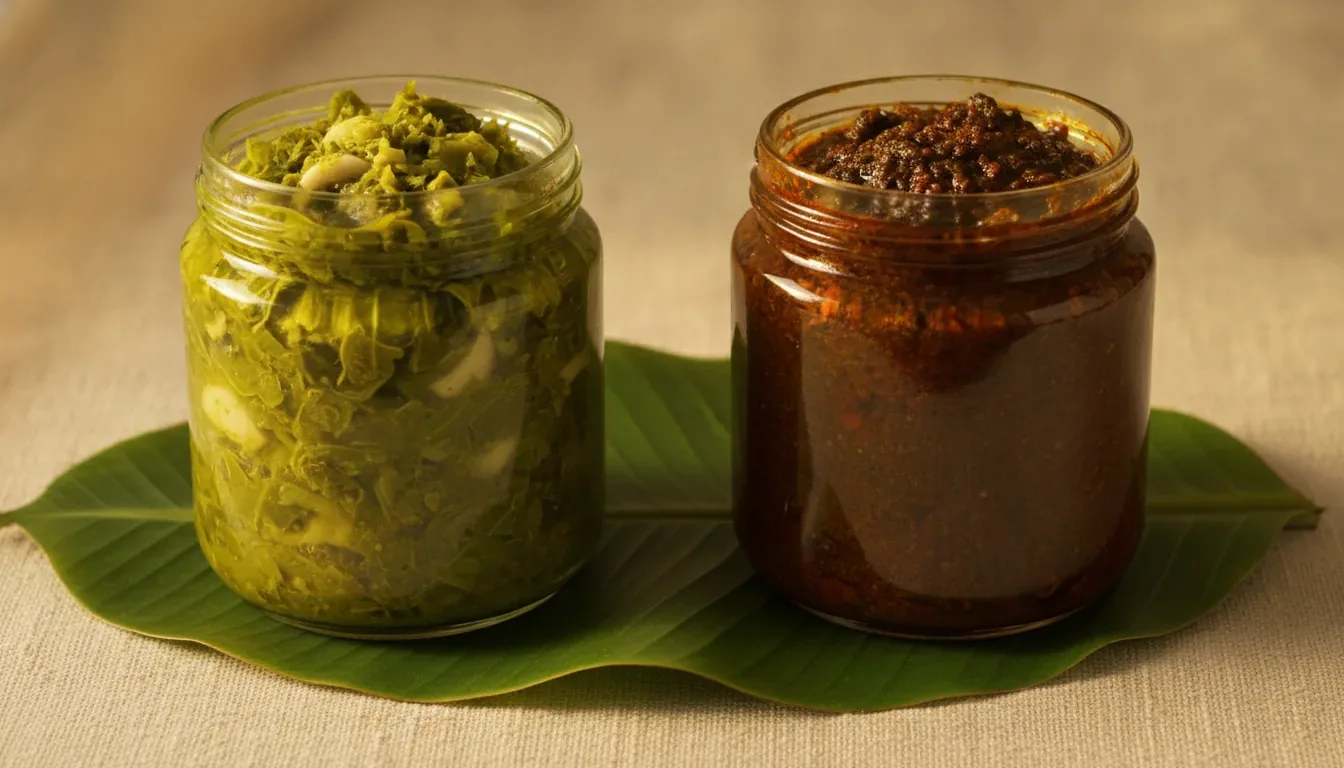
You can often tell them apart at a glance too. The fresh pachadi is looser and brighter, a spoonable green that looks recently made. The pickle is darker and denser, slicked with oil and usually carrying a visible oil layer on top, the sort of jar built to sit in a cupboard.
| Gongura pachadi (fresh) | Gongura pickle (nilva pachadi) | |
|---|---|---|
| What it is | Fresh side dish, chutney style | Preserved keeping-pickle |
| Leaf prep | Boiled or lightly sauteed, moisture kept | Wilted or sun-dried, moisture removed |
| Water | Some, to soften the leaf | None |
| Salt & oil | Light | Heavy, sealed under oil |
| Consistency | Soft, spoonable | Thick, dense |
| Shelf life | A few days, up to about 1–2 weeks refrigerated | Months at room temperature |
| Eaten | Now, with rice, idli or dosa | Over time, a little at a meal |
Run your eye down the shelf-life row and the split explains itself. A gongura nilva pachadi earns its months through oil and salt; the fresh pachadi trades that keeping power for a brighter, softer, just-made taste. Neither is the better one. They are made for different jobs.
What actually makes one keep and one spoil
Here is the part a recipe card skips and an AI summary glosses over. Spoilage is a moisture problem, and every step of the pickle exists to solve it.
Fresh gongura holds a lot of water. Cook it lightly, grind it soft, and that water stays in the paste. Water is exactly what microbes and mould need to grow, which is why a fresh gongura pachadi has to be eaten within a few days and kept cold after that. It tastes good because it is wet and green and just-made, and that same wetness is why it cannot sit out on a shelf.
The pickle is built the other way round. What is nilva pachadi, mechanically? It is gongura with the water taken out, and then kept out. The leaves are wilted or sun-dried first, sometimes over a day or two, until they give up most of their moisture. They are cooked down hard in oil. Plenty of salt goes in, and the whole thing is sealed under a layer of oil with no water anywhere near it. Salt draws moisture out of any microbe that tries to settle. Oil caps the surface and keeps air and damp off it. Dry leaf, heavy salt, oil seal: there is nothing left for spoilage to feed on.
Tempering earns a mention here as well. Both forms get a popu (tempering, also called tadka), the sizzle of mustard seeds, dry chilli and garlic in hot oil that carries the flavour. In the fresh pachadi that tempering is added late and stays lively. In the pickle the oil is not a finishing touch; it is the medium the whole thing lives in, poured over and sealed so the leaf never meets air or water again.
This is the same logic that runs avakaya, the archetypal Andhra mango pickle, where raw mango is salted hard and held under oil to last a year. Gongura pickle borrows that playbook. The heat comes from dry red chilli, often Guntur chilli at 30,000–50,000 Scoville heat units, which lands as a firm, building warmth rather than a sharp sting, and the salt and oil carrying it are doing preservation work as much as flavour work. Get the moisture wrong and no amount of chilli will rescue the jar.
Which should you buy or make?
The gongura pickle vs pachadi choice comes down to how quickly you will finish the jar.
If you cook Andhra meals through the week and want that fresh, tangy note beside hot rice, idli or dosa over the next few days, the fresh pachadi is the one. Make it or buy it in small quantity and keep it in the fridge. If you want gongura on hand for months, to post to family, to carry while travelling, or to spoon a little at a meal without cooking a thing, the pickle or nilva pachadi is what you are after. That is also why the pickle tends to cost more by weight and shows up in 1kg keeping-jars: the drying, the extra oil, the longer cook and the shelf life are all priced in.
You will also see either form labelled Andhra style, village style or Brahmin style. Those mark regional and household tweaks to the same two forms, not a third category. Is gongura pickle the same as pachadi? Yes and no, and now you can say which. The pickle is a pachadi, the preserved one; pachadi on its own, in everyday use, means the fresh one. If you want to make either at home, a full method for both the fresh and the keeping versions is a separate read.
The sorrel behind both
Gongura is no niche ingredient to an Andhra kitchen. Along with Guntur chilli, it is one of the two things that make the food taste like home. At Nandhini, that same red sorrel goes into gongura mamsam (gongura mutton), where the leaf is cooked fresh into a dish rather than dried into a jar. Handling the leaf both ways, day in and day out, is what lets a working Andhra kitchen tell you why the fresh leaf behaves one way on the plate and another in the pickle pot. Nandhini has cooked with gongura in Bengaluru since 1989. To taste what the fresh leaf does in a dish, the gongura mamsam guide is the place to look.
Frequently asked questions
What is the difference between gongura pickle and gongura pachadi?
Pachadi is the fresh version, with the leaves cooked and ground into a soft chutney and eaten within days. The pickle is a nilva pachadi: the leaves are wilted or sun-dried, then sealed in salt and oil so it keeps for months. Same leaf, different preservation.
What are the two types of gongura?
The two forms are the fresh gongura pachadi, made to eat now, and the preserved gongura pickle or nilva pachadi, made to keep. Both use the same red sorrel leaf; the difference is whether moisture is kept in or driven out for storage.
What is gongura pachadi made of?
Fresh gongura pachadi is made of red sorrel (gongura) leaves cooked down, then ground with a tempering of dry red chilli, garlic, cumin and salt in oil. Some styles fold in peanuts or sesame. It is soft, tangy and eaten fresh.
Is gongura pickle the same as nilva pachadi?
Yes. Nilva, also written niluva, means long-keeping, so a nilva pachadi is the storage version of the condiment, which is what English speakers call gongura pickle. In Telugu, pachadi is the umbrella word and the pickle is simply its preserved member.
How long does gongura pachadi last compared with the pickle?
Fresh gongura pachadi lasts a few days, up to a week or two refrigerated, because it still holds moisture. The oil-sealed pickle keeps for several months at room temperature, since the leaves are dried first and water is kept out of the jar.