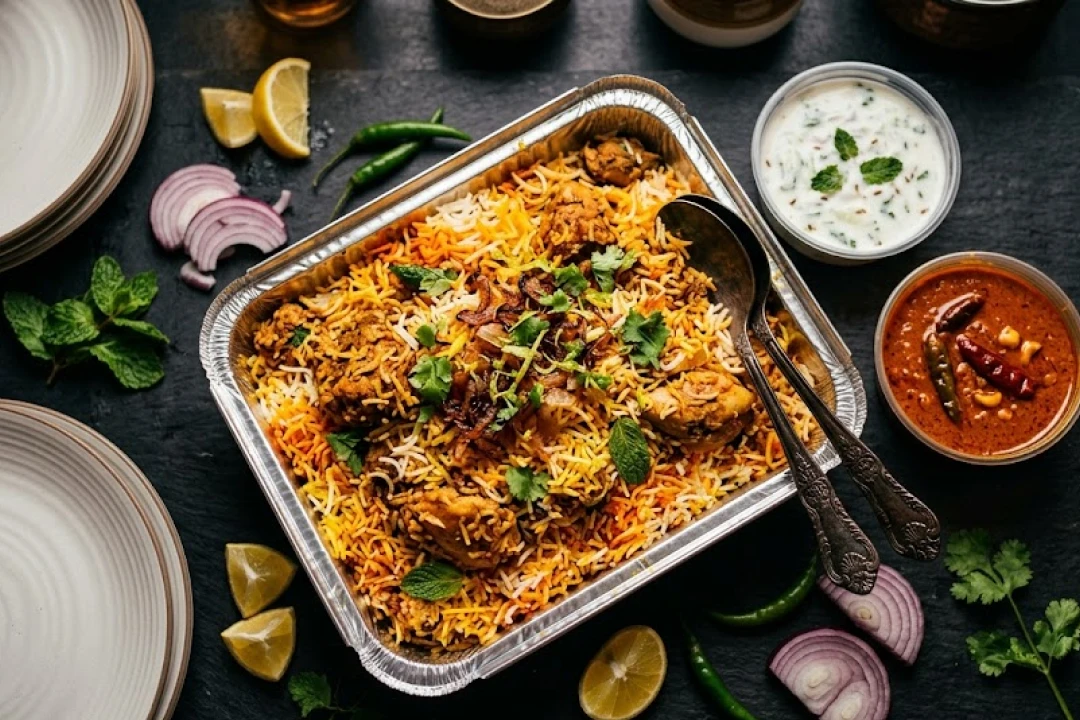
A standard biryani family pack feeds 3 to 4 adults when biryani is the main dish, and 4 to 5 adults when paired with sides or starters. That is the short answer. The longer answer depends on three things you can adjust before you tap order: who is eating, what else is on the table, and whether you are running one biryani lane or two.
We sell family pack biryani at lunch volume across our outlets in Bangalore and Mysuru, so the numbers below are not guesses. They are what comes back as empty plates. Here is the sizing matrix, the per-person math, and the rule that solves most over-ordering before it happens.
The Sizing Matrix
Pick the row that matches your group. The kg ranges assume a standard family pack of roughly 1.2 kg of cooked biryani. Most Bangalore vendors – us included – label these packs serves 3 to 4. That label assumes biryani is the only main dish, no sides on the table, and adult appetites.`
| Group size | Biryani only | With 1 side | With 2 sides + starter | Pack maths |
| 3 adults | 1 kg | 1 kg | 1 kg | 1 family pack |
| 4 adults | 1.2–1.4 kg | 1.2 kg | 1.2 kg | 1 family pack |
| 5 adults | 1.8 kg | 1.4–1.6 kg | 1.2–1.4 kg | 1 large pack or 1 family + half |
| 6 adults | 1.8–2.2 kg | 1.6–1.8 kg | 1.4–1.6 kg | 2 family packs (run two lanes) |
| 8 adults | 2.5–3 kg | 2.2–2.4 kg | 2 kg | 2 family packs + starter |
| 10 adults | 3.2–4 kg | 2.8–3.2 kg | 2.5–2.8 kg | 3 family packs in 2 lanes |
Biryani for 4 People
One family pack. About 1.2 to 1.4 kg of biryani, which lands at the 350g-per-adult benchmark. If you are adding a starter or a raita, one pack is enough. If biryani is doing all the work alone, edge toward 1.4 kg or add a side – it is cheaper than upsizing the rice.
Biryani for 6 People
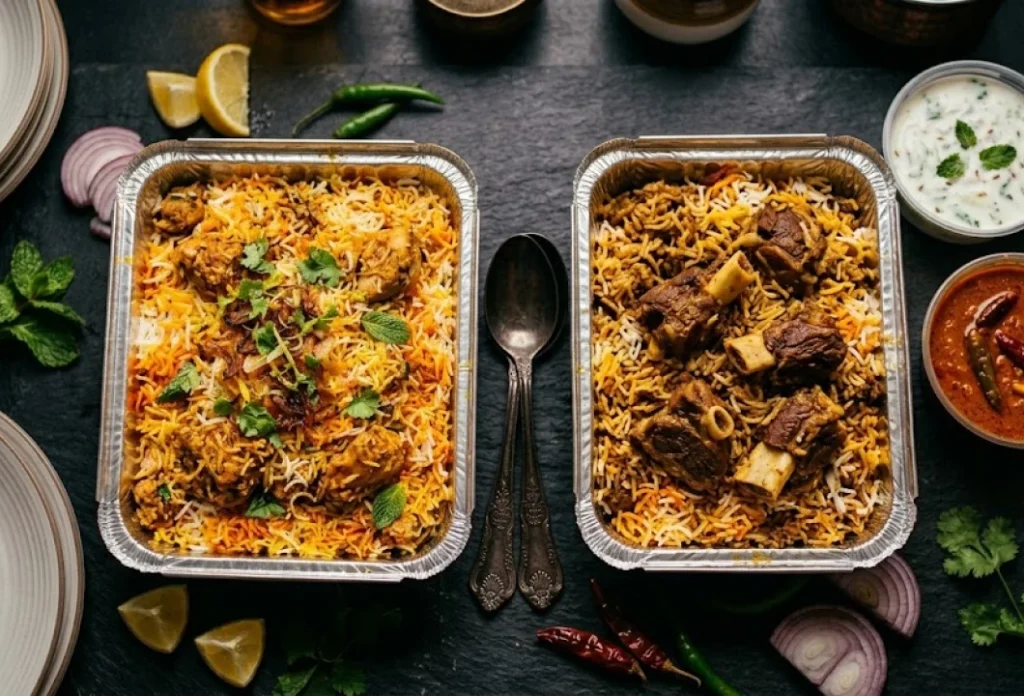
Roughly 1.8 to 2.2 kg. Two family packs run in parallel works better than one oversized pack: you can split the order across veg and non-veg, or comfort chicken and a spicier Andhra mutton. The variety keeps everyone happy and the leftovers down. One cooling side – raita, salan, or a yoghurt-based gravy – makes the meal feel complete.
Biryani for 8 People
Plan for 2.5 to 3 kg. This is where the two-lane logic starts to pay off: one veg, one non-veg, or one mild, one spicy. Add two starters and one cooling side. A single 3 kg pack of one flavour gets repetitive by the third plate; two 1.5 kg packs across two flavours keeps the table moving.
Biryani for 10 or More
Roughly 3.2 to 4 kg, usually three family packs across two lanes. Past 10 people, you are not really ordering family packs any more – you are running a small event. For groups of 15 or more, switch to large-group ordering and Andhra catering, which uses different vessels, different pricing, and a different sizing formula.
Why the ranges? Three variables move the number around. Bone-in biryani yields less edible food per kg than boneless – the bones are weight you do not eat. Mutton packs feel denser than chicken at the same weight, so people eat slightly smaller portions. And kids under 10 count as half an adult, give or take. If your group is mostly kids, the matrix gives you headroom; if your group is mostly post-cricket cousins, edge to the top of the range.
The Per-Person Math (and Why “1 kg Feeds X” Answers Vary)
If you want one number to remember, it is this: 350 to 400 grams of cooked biryani per adult when biryani is the main dish. Children under 10 land at 250 to 300 grams. Add a 10 to 15 percent buffer for celebrations, festivals, or any meal where second helpings are expected.
Search 1 kg biryani serves how many and you will get answers ranging from 3 people to 8. They are all almost right and all incomplete. One kilogram of biryani feeds 3 adults solo, and 4 adults when there are sides on the table. The internet disagrees because the question itself is incomplete – the answer changes by 100 grams per person depending on what else you are serving.
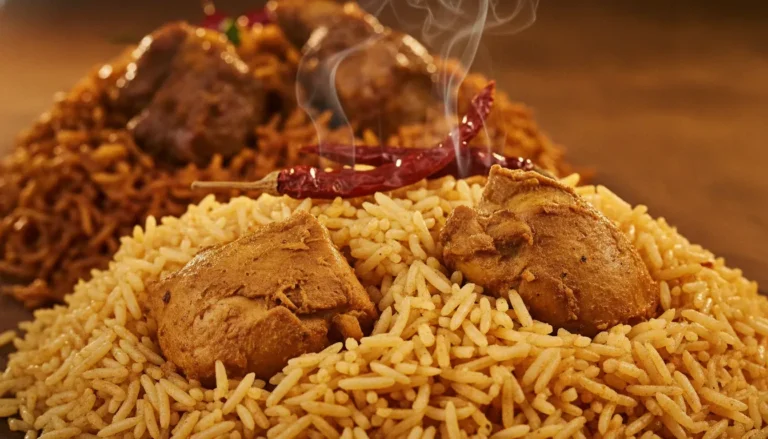
Boneless lanes stretch further than bone-in. A boneless chicken biryani family pack delivers more edible biryani per kg than the same weight of bone-in mutton, because none of the weight is bones. Mutton biryani also tends to feel heavier per spoonful – people eat slightly less of it. If your group is non-veg and you are choosing between a 1.5 kg chicken pack and a 1.5 kg mutton pack, the chicken stretches to one more plate. Pair either with the right best sides to add to your family pack and you can stretch a 1.5 kg pack to feed 5 people without anyone leaving hungry. The math works because raita, salan, and a starter fill the same plate biryani would have.
If you want a deeper breakdown of which add-ons stretch a pack the furthest, our biryani combos with sides page lays out the pairings outlet by outlet. For very small groups, the biryani sizing for smaller group page handles the 1 to 2 person case the family pack matrix above is not built for.
How to Order a Biryani Family Pack Without Over-Ordering
Three rules. They will solve most over-ordering before it happens.
Rule one: count adult equivalents, not heads. Two adults and two children under 10 is three adult equivalents, not four. Round up only if the kids are teenagers.
Two: decide what else is on the table before you pick the pack size. The matrix above shifts by a full kg between biryani-only and biryani-with-sides. Choosing the pack first and the sides later usually leads to a pack that is one tier too big.
And the third – the one that saves the most leftovers – for groups of six and above, run two lanes instead of one oversized pack. Two 1.2 kg family packs in different flavours beat one 2.4 kg single-flavour pack every time. The reasons are practical: variety holds attention, mixed groups (veg eaters, kids who do not like spicy, the one cousin who only eats chicken) get something they want, and the leftovers split cleanly across two containers instead of one giant one.
Most Bangalore family packs – including ours – are labelled serves 3–4. That label is built on the biryani-only assumption: no sides, adult appetites, no kids in the count. If your table looks different, the label needs adjusting before you order.
For a detailed breakdown of pack sizes, combos, and what each tier actually contains, how to actually order a family pack walks through the order flow from cart to door.
When to Add Sides vs Upsize the Biryani
Sides do more than fill the plate – they change the math. Adding one cooling side, a raita or a salan, reduces the biryani-per-person need by about 15 percent. Adding two sides plus a starter reduces it by 25 percent. That is one full tier of pack size for most groups.
They are also usually cheaper than upsizing biryani. If you are deciding between a 1.5 kg pack with no sides and a 1.2 kg pack with raita and a starter, the second option lands better on the table, costs less, and leaves smaller leftovers. The exception is when biryani is the event – a birthday lunch where everyone is there for the biryani specifically. Then upsize and skip the side.
Past ten people, you are not in family-pack territory any more. The vessels are different, the timing is different, the math is different. Large-group ordering and Andhra catering handles the 15+ scale with servings calculated per head, not per pack.
What to Do With Leftover Biryani
Even with the math right, leftovers happen. Biryani keeps well: 2 to 3 days refrigerated in an airtight container, up to 4 weeks frozen in portion-sized bags. The rice holds its texture if you cool it within an hour of serving rather than leaving it on the counter.
For freezer storage timing, container types, and what to do with the saffron strands, our how to store biryani leftovers guide covers the full process. For the reheat itself – stovetop versus microwave versus oven, and which biryani styles survive each method –reheating biryani properly is the page that handles it.
One thing the matrix should never become is an excuse to over-order. Leftovers are a fix for a misjudged group, not a goal. If your office order is for eight people, plan for eight – not for eight plus tomorrow’s lunch. The math holds better the closer the order tracks the actual group.
How Nandhini Sizes a Family Pack
Our family pack labelling is the same standard you will see across Bangalore – serves 3 to 4 – but the number comes from somewhere specific. We have been selling family pack biryanis at lunch volume across 15+ outlets in Bangalore and Mysuru for 37 years. The 3 to 4 number is not a marketing line. It is the count we arrived at by watching plates come back empty across roughly 10,000 orders a week.
What a Nandhini family pack actually contains: about 1.2 kg of biryani in your chosen lane – chicken, mutton boneless, mutton bone-in, or veg – sealed for travel, with raita and salan packed separately to hold their temperature. The Andhra-style biryani we serve is drier than Hyderabadi, which means it travels better in a family pack and reheats without going gummy.
Two service patterns we see often: weekend family dinners ordered from our Jayanagar and St. Marks Road outlets, where the pack arrives ready to go straight to the table; and weekday office orders from Koramangala and the surrounding tech belt, where two-lane ordering (one chicken pack, one veg) handles mixed teams cleanly. Which biryani style travels best in a family pack covers the choice between Andhra and Hyderabadi for delivery.
Family Pack Biryani: Common Questions
How many people does a biryani family pack feed?
A standard biryani family pack feeds 3 to 4 adults when biryani is the main dish, or 4 to 5 adults when paired with starters or sides. Add roughly 0.5 servings per child under 10. Mutton packs feed slightly fewer people than chicken packs of the same weight.
How much biryani do I need for 4 people?
For 4 adults with biryani as the main dish, order about 1.2 to 1.4 kg of biryani, roughly one standard family pack. If you are adding starters or raita, one family pack is enough. If biryani is the only main dish, edge toward 1.4 kg or add a side.
How much biryani do I need for 6 people?
For 6 adults, order about 1.8 to 2.2 kg of biryani, typically one large family pack plus a smaller portion, or two family packs split between veg and non-veg lanes. Pair with one cooling side like raita to make the meal feel complete.
How much biryani do I need for 8 people?
For 8 adults, order about 2.5 to 3 kg of biryani, usually two family packs run in parallel lanes (one comfort, one spicy, or one veg and one non-veg). Add two starters and one cooling side. Two lanes work better than one oversized pack for groups this size.
How much biryani per person should I order?
Plan for 350 to 400 grams of biryani per adult when biryani is the main dish, and 250 to 300 grams per child under 10. Reduce by about 15 percent if you are serving starters and sides. Add 10 to 15 percent buffer for celebrations or hungry crowds.
How many people can 1 kg of chicken biryani feed?
One kilogram of chicken biryani feeds 3 adults comfortably when biryani is the main dish, or 4 adults when served with starters and sides. Boneless biryani yields slightly more servings per kilogram than bone-in because more of the weight is edible meat and rice.
Is one family pack enough for a small office lunch?
One family pack feeds 3 to 4 adults, enough for a small huddle or pod, but not a full team. For a team of 6 to 8, plan for two family packs in different lanes (one veg, one non-veg, or one mild, one spicy) plus a side. This avoids both shortages and leftovers.
The Short Version
One family pack feeds three to four. Two lanes feed six to eight. Sides stretch the math by 15 percent. Kids count as half. Past ten people, it stops being a family pack and starts being a small event. That is the whole article in five lines. We have been getting these numbers right since 1989; the menu is ready when you are. Find your nearest Nandhini outlet to place your order – and the plates will tell you we got the sizing right.